Monday, July 15, 2013

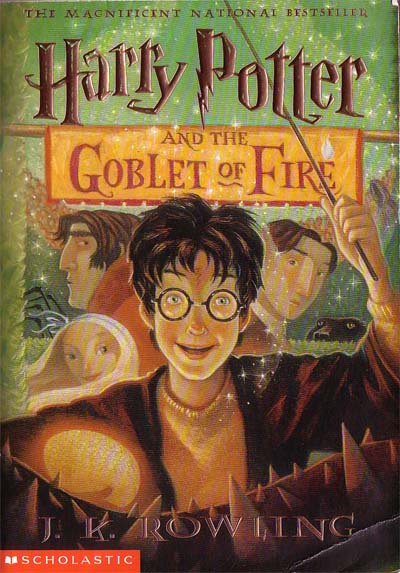
Harry Potter and the Goblet of Fire

Book: Harry Potter and the Goblet of Fire by J. K. Rowling

Description: Harry Potter is midway through both his training as a wizard and his coming-of-age. Harry wants to get away from the pernicious Dursleys and go to the Quidditch World Cup with Hermione, Ron, and the Weasleys. He wants to dream about Cho Chang, his crush (and maybe do more than dream). He wants to find out about the mysterious event that's supposed to take place at Hogwarts this year, an event involving two other rival schools of magic, and a competition that hasn't happened for hundreds of years. He wants to be a normal, fourteen-year-old wizard. But, unfortunately for Harry Potter, he's not normal--even by Wizarding standards.

And in his case, different can be deadly. (book flap)

My Thoughts: Goblet of Fire is another solid Harry Potter book! I'll admit that it's never been one of my favorites, but I thoroughly enjoyed it on this last reread. Harry and his friends develop during the book, the adventures they have are gripping and well-written, and the mystery of the book (what is behind all the strange, ominous happenings both at Hogwarts and in the outside world) is nicely tangled and confusing until the final reveals.

Goblet of Fire continues the trend of Prisoner of Azkaban of bringing Harry and Hogwarts more into contact with the outside wizarding world. Harry goes to the Quidditch World Cup, where he sees wizards from all over the world, and because of the Triwizard Tournament (that would be "the mysterious event" from the book flap) there are many Ministry and foreign wizards at Hogwarts. Harry also begins to find out more about the past of the wizarding world in general and what it was like when Voldemort was still in power.

The conclusion of the Triwizard Tournament was what truly gripped me during this read. It was so suspenseful and well-written--the evil of the whole situation was just dripping off the page--, and fast-paced in a way that felt truly realistic. Harry's reaction after everything had been resolved felt so perfect to me--he seemed shocked, exhausted, horrified, and so much else all at the same time.

The conclusion to the whole book also highlighted a lot of the Christian messages for me. It was very poignant (I almost cried) and very much about doing the right thing despite the costs (which were much worse this book). Dumbledore is fighting for the truth whatever the cost, and trying to encourage his students to do the same. Again, Rowling is not sugar-coating the costs of doing the right thing in the face of unspeakable evil.

Thursday, July 11, 2013

Harry Potter and the Prisoner of Azkaban

Book: Harry Potter and the Prisoner of Azkaban by J. K. Rowling

Description: For twelve long years, the dread fortress of Azkaban held an infamous prisoner named Sirius Black. Convicted of killing thirteen people with a single curse, he was said to be the heir apparent to the Dark Lord, Voldemort.

Now he has escaped, leaving only two clues as to where he might be headed: Harry Potter's defeat of You-Know-Who was Black's downfall as well. And the Azkaban guards heard Black muttering in his sleep, "He's at Hogwarts ... he's at Hogwarts."

Harry Potter isn't safe, not even within the walls of his magical school, surrounded by his friends. Because on top of it all, there may well be a traitor in their midst. (from the book flap)

My thoughts: I absolutely loved this book!! Prisoner of Azkaban has always been my favorite Harry Potter book, and it was great to reread it.

Harry and his friends are older now, and they begin to deal with more difficult situations. Friendship, loyalty, betrayal, and love are all important themes of the book, and all are dealt with in a more adult way than before. In Prisoner of Azkaban Harry and his friends have their first sustained contact with the adult world of wizardry, especially the Ministry of Magic. This is also the first book in the series where adult wizards and their problems are a huge aspect of the plot. Finally, this is the first book to not have a completely perfect ending. Harry, his friends, and his readers are all growing up and discovering that the world can be a complicated place.

Prisoner of Azkaban also introduces some of my favorite characters, Professor Lupin and Sirius Black himself (if you haven't read it yet, you'll see why. I promise). Professor Snape also has a great role; almost every time he speaks, I laughed.

Finally, this is the first book where Rowling's impressive world-building really comes up. One of the reasons many people say that the Harry Potter novels are so popular is because Rowling did an exquisite job at building the wizarding world around the reader: she references many normal aspects of wizarding life in passing, such as the crazy magical candy like Ice Mice (which jumps in your stomach--eek!), and in ways that make it seem like just another part of life. The detail she provides, without  overwhelming the reader at any one time with massive amounts of description, makes it almost laughably easy to imagine the wizarding world. Anyway, the reason that I mentioned this here is because this is the first book where passing remarks made in earlier books have been relevant; Hagrid mentioned Sirius Black in the very first chapter of Philosopher's Stone. It is not the last time that important characters are mentioned books before they ever become important.

As to the Christian aspect/suitability of these books: the flawed nature of the outside world especially, but also of some people at Hogwarts, is highlighted in these books. Harry and his friends fight to do what is right, even at great cost to themselves. Rowling shows the difficulty of these choices and the costs that they have to pay for these choices while still leaving no doubt in the reader's mind that their choices were noble and good. The dementors (dark figures who drain the happiness out of anyone who gets too close to them) are similar to the nature of the world in many ways, which attempts to drain us of our joy and swallow us in fear.

By far my favorite Harry Potter book, and the first to truly grapple with problems of the world and doing right.

Monday, July 8, 2013

Harry Potter and the Chamber of Secrets

Book: Harry Potter and the Chamber of Secrets by J. K. Rowling

Description: The Dursleys were so mean and hideous that summer that all Harry Potter wanted was to get back to the Hogwarts School for Witchcraft and Wizardry. But just as he's packing his bags, Harry receives a warning from a strange, impish creature named Dobby who says that if Harry Potter returns to Hogwarts, disaster will strike.

And strike it does. For in Harry's second year at Hogwarts, fresh torments and horrors arise, including an outrageously stuck-up new professor, Gilderoy Lockhart, a spirit named Moaning Myrtle who haunts the girls' bathroom, and the unwanted attentions of Ron Weasley's younger sister, Ginny.

But each of these seem minor annoyances when the real trouble begins, and someone--or something--starts turning Hogwarts students to stone. Could it be Draco Malfoy, a more poisonous rival than ever? Could it possibly be Hagrid, whose mysterious past is finally told? Or could it be the one everyone at Hogwarts most suspects... Harry Potter himself? (book flap)

My Thoughts: I thoroughly enjoyed The Chamber of Secrets. As with the first book, it is still a children's book through and through, and contains nothing too heart-rending or emotionally challenging. Again, the mystery of the year (this time who is opening the Chamber of Secrets and how) was engaging and well-plotted.

A huge part of my enjoyment of Chamber of Secrets was the characters. Dobby and Professor Lockhart especially were loads of fun to read, and I laughed out loud every time either of them showed up.

I was struck after reading the final confrontation how symbolic of spiritual warfare it was in many ways. *spoiler alert* Fawkes, Dumbledore's representative while he is absent (the Holy Spirit?), completely saves Harry from the clutches and powers of evil (Tom Riddle/Voldemort and the basilisk), but only after Harry has shown his loyalty to Dumbledore; although Harry deals the death blow to both, he could not have done it without the encouragement and actions of Fawkes. *end spoilers* Also, the worldly perceptions of Harry, Ron, and Hermione was shown to be flawed, as they were unable to see who the true perpetrator was until he revealed himself.

A solid second book of the Harry Potter series. I saw Christian influences more clearly in this book than the first; it is also better written than the first.

Thursday, July 4, 2013

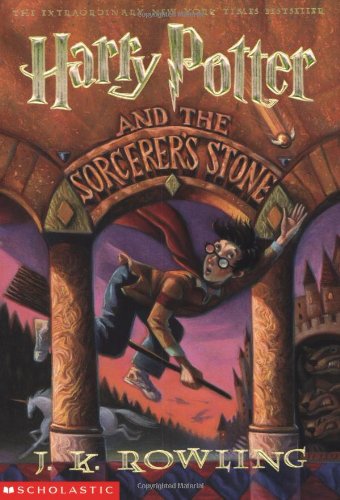
Harry Potter and the Philosopher's Stone

Book: Harry Potter and the Philosopher's Stone by J. K. Rowling*

Description: Harry Potter has never played a sport while flying on a broomstick. He's never worn a cloak of invisibility, befriended a giant, or helped hatch a dragon. All Harry knows is a miserable life with the Dursleys, his horrible aunt and uncle, and their abominable son, Dudley. Harry's room is a tiny closet at the foot of the stairs, and he hasn't had a birthday party in eleven years.

But all that is about to change when a mysterious letter arrives by owl messenger: a letter with an invitation to a wonderful place he never dreamed existed. There he finds not only friends, aerial sports, and magic around every corner, but a great destiny that's been waiting for him... if Harry can survive the encounter. (from the back of the book)

My Thoughts: Philosopher's Stone was a fun read. Rowling uses satire a great deal in all of the Harry Potter books, including this one. Her descriptions of the Dursley family are hilarious and almost seem like a family that you or I could meet walking down the street. She pokes a great deal of fun at human nature in wizards and non-wizards (Muggles) alike. The wizarding world if full of quirky characters, and I love the idea of a world where being quirky is almost an advantage.

I will admit that this has never been one of my favorite Harry Potter books. Rereading it now, after a good long time away, I think that it has a lot to do with the fact that this is Rowling's first book. Her style develops for the better over the series, but in this first book it is more telling and less showing than I tend to prefer.

Philosopher's Stone is a children's book; it was odd to come back to a children's book after reading the whole series, which matures in content and style as Harry does. Harry and the other children definitely do seem like children of 11 and 12, which are their ages in this book.


*A note to the curious: Although I will be using pictures of the American covers because I think Mary Grandpré's cover designs are absolutely beautiful, I have kept Rowling's original title despite it being changed by her American publishers because they thought no child would read a book with the word 'philosopher' in the title)

Monday, July 1, 2013

Why I read Harry Potter

Many Christians argue that Christians should not read the Harry Potter books because of the magical content (obviously I'm not one of them, but two good arguments against reading it can be found here and here). God clearly condemns those who use magic: 
When you enter the land the Lord your God is giving you, do not learn to imitate the detestable ways of the nations there. Let no one be found among you who sacrifices their son or daughter in the fire, who practices divination or sorcery, interprets omens, engages in witchcraft, or casts spells, or who is a medium or spiritist or who consults the dead. (Deuteronomy 18:9-11)

And I am not advocating the use of magic. On the contrary, I condemn it along with all other immoral behaviors. I am, however, advocating reading books that contain magic IF the magic and the story are uplifting and godly. It is closed-minded to refuse to read books only because they contain magic. Anyone who did that would miss such wonderful books as Grimm's fairy tales, various incarnations of the King Arthur legend, the Narnia books, Lord of the Rings... The list goes on. Should Christians stop reading these as well? That seems ridiculous; the Narnia books, along with the Harry Potter books, are some of the most Christian books I've ever read.

The Harry Potter books are, ultimately, tales of good versus evil, of the power of love and friendship and loyalty even against the most impossible odds. Yes, Harry and his friends make mistakes and act immorally, but ultimately they always make the right choices. This is a series and a world that encourages readers to stand up for what is right and to stand against injustice--whether that be bullying of children in school or murderous dictators taking over the country--in any and every way they can, even if it leads to death. This is a series that never questions what is good and what is evil, a true rarity in modern literature. I find it refreshing. While Rowling--rightly--does not gloss over the costs that these decisions can have, her characters make those decisions anyway. They may not always make the right decisions, and Rowling does not hesitate to show the human brokenness of each and every character, but almost every character ultimately tries to do what is right simply because it is right. This is unbelievably refreshing in a literary world full of characters who do only what is easy, convenient, or expected of them.

These books were not meant to lead children into witchcraft or occult practices; Rowling herself said in 1999, "I absolutely did not start writing these books to encourage any child into witchcraft. I'm laughing slightly because to me, the idea is absurd." If anything, the magic of the Harry Potter world helps the characters and the readers come to know God and His nature better.

I will expand on these themes for the rest of the month; I hope this has helped clarify things for you readers. I would love to hear your thoughts in the comments!

Please know also that I whole-heartedly respect the choice of anyone who chooses to not read the Harry Potter books if she/he is concerned about how the use of magic will affect her/him. I freely admit that there are plenty of books that I don't read because of my Christianity and relationship with God! All Christians should prayerfully consider their reading choices, and ultimately God is the judge of those choices.

Note: Much of my thinking about this topic was influenced by John Granger's book Looking for God in Harry Potter. I cannot recommend this book enough to anyone who is curious about the Christian symbolism and themes in the Harry Potter books. While researching the topic, I saw that Granger has also released a second book, How Harry Cast His Spell: The Meaning Behind the Mania for J. K. Rowling's Bestselling Books, which I have not read but would imagine was just as good as the first book with the added bonus of actually including all seven books in the analysis (Looking for God... only goes up to the fifth book).

Friday, June 28, 2013

July is Harry Potter month!

In honor of Harry Potter's birthday (July 31), I've decided to dedicate the month of July to Harry Potter posts.

I'll admit, I'm a huge fan. I have been ever since I read the first book. I know many Christians refuse to read the books because of their content, especially the magic, so I wanted to talk about the series and my perspectives. I'll start the month going into more detail about why I see no conflict between my faith and the Harry Potter books, and why I love them so much; then I'll review each of the seven books in the series, and finish the month with a final conclusion post.

I hope you enjoy, or at least prayerfully consider what I write!

Monday, June 24, 2013

Just a quick announcement: I am taking this week off from blogging.

I hope everyone has a blessed week!

Thursday, June 20, 2013

Virus Hunters

Book: Virus Hunters by Greer Williams

Published: 1960

Description: Williams describes the work of hunting for viruses and their cures throughout history, as well as the people who were a part of that work. (My own description)

My Thoughts: I bought Virus Hunters at a library book sale, and am very happy with my choice. It was a really fun and fascinating read!

Virus Hunters is about both the science of learning more about viruses and the people who do that science. It is written for anyone, whether they have a science background or not, but Williams does not avoid the scientific details. He does not go into step-by-step instructions for how to do each relevant experiment, for instance, but he does explain the general science of it. As someone who loves learning about science, I appreciated his explanations, which I found to be helpful and easy to understand.

However, this book is much more a book about the people who hunt for viruses. This is especially true of the first few sections, where Williams goes into great detail about Dr. Edward Jenner, who created the first vaccine (for smallpox), and Louis Pasteur, who created a vaccine for rabies. He then goes into less detail about other virus pioneers, and almost none by the end of the book as he described current developments. These details about the people involved--their life stories, their personalities, their motivations--were by far the most fascinating aspects of Virus Hunters.

Williams has faith in the scientific method (perhaps too much), although he does not overly idolize most of the figures he mentions. He talks about their faults as well as their good work and traits.

The other interesting aspect of Virus Hunters was simply the fact that it was written over fifty years ago. It was fascinating to read about science as it was done then, as well as what Williams saw as important. Polio, for instance, was a huge topic that is hardly discussed no, as there is a working vaccine and polio has been eliminated from developed countries; HIV/AIDS were not discussed at all, because of course it wasn't discovered for another twenty years at least. The idea of vaccines against colds and cancer (which Willliams argued may be caused by viruses) made me laugh, simply because more than fifty years later, we are no closer to finding cure-alls for either colds or cancer (although, of course, some cancers can be cured now. Some are even caused by viruses, and vaccines exist--for instance human papillomavirus causing cervical cancer).

Virus Hunters was a fun, interesting read--Williams was an engaging writer and the subject matter was fascinating.

Monday, June 17, 2013

The Dove in the Eagle's Nest

Book: The Dove in the Eagle's Nest by Charlotte Yonge

Published: 1866

Description: Christina was raised by her God-fearing and respectable aunt and uncle until her father returns and forces her to return with him to the den of thieves he calls home--for her father is a bandit, and now Christina must live among them. (My own quick summary)

My Thoughts: I ran across a mention of The Dove in the Eagle's Nest in a reading for class and thought it sounded just so interesting that I downloaded it from Project Gutenberg almost right away.

I was not disappointed. The Dove in the Eagle's Nest was a great read. It was written in the 1860s, and definitely was rather Victorian in its emphases, especially on the gentling, kindly effect of a virtuous woman. Christina is fantastically good at civilizing everyone around her. Christianity was a huge part of her influence, however, and I loved the Christian atmosphere of the book. There was an emphasis on doing what is right simply because it is right. Perhaps my one objection to the book was the fact that Christianity came across as useful and good only in that it helps to civilize and gentle those who would otherwise be cruel and violent. Of course God does that, but Christianity is so much more! It is never good to see Christianity as only a means to an end--God is so much bigger than that, and He will not be used. We must come to Him on His terms or not at all.

I also really enjoyed the setting of The Dove in the Eagle's Nest: late 15th and early 16th century Germany (although of course at the time it was just hundreds of independent principalities), just before the Reformation. Yonge obviously viewed the historical setting as important for the novel (the book has a preface and epilogue, both dealing with the historical context), and many political events did end up becoming important. It was a very pleasant way to learn about a specific period of German history.

The Dove in the Eagle's Nest was a very pleasant, enjoyable read. Definitely recommended!

Thursday, June 13, 2013

The Story of Art

Book: The Story of Art by Sir E. H. Gombrich

Description: "The Story of Art", one of the best-known and best-loved books on art ever written, has been a world bestseller for over half a century. Professor Gombrich's clear and engaging text combines with hundreds of full-colour illustrations to trace the history of art in an unfolding narrative, from primitive cave paintings to controversial art works of the present day. (From Amazon.com)

My Thoughts: The Story of Art was very informative and interesting without overwhelming the reader with artists or vocabulary or dates.  It was also extremely effective at showing how art evolved in a way that can be understood, how one style led to another led to another, and especially how all art can be understood if you think about what the artist was trying to achieve. Yes, it may not be 'realistic', but the artist may not have wanted to do that, it may have gotten in the way of what he wanted to do (for instance in the Middle Ages the goal of artists was to teach and be informative with their art, not to mimic nature). I really, really love how Sir Gombrich takes each movement individually and explains their aims without seeming to judge them. He made some really great points about how what we see and expect when we look at art today isn't what was seen and expected when the art was created--this book very much widened my perspective on why art was created the way it was. It was very thoughtfully written, almost like a philosophy of the study of art in some parts. Sir Gombrich clearly loves art. He knows how to 'read' it (something that very much has to be learned) and is good at explaining it.

Sir Gombrich is all about making people think about art and enjoy it--but not just enjoy it because it's beautiful or because it's skillfully done, but also to learn about the story behind a piece, to think about why it was created and how that influences how it was made--and definitely not to go see art and pretend to enjoy it because it's the 'cultured' thing to do. He wants to create people who really do enjoy and understand art.

My one objection to The Story of Art is its western perspective. Sir Gombrich admits this bias early on, and gives what I think are valid reasons for it--but his first chapter, on "primitive art," shows this bias again. His idea about why their art is so what I would call 'abstract' were compelling, logical, and understandable, but also condescending (hopefully unintentionally).

I would definitely recommend this book. especially to anyone who wants to learn about art history without being bombarded by terms and especially dates.  Very understandably written, and very interesting.  I would recommend the full-sized version, though, rather than the pocket version that I bought (flipping back and forth between the pictures and the text was annoying, even if the size really was great for traveling).