Showing posts with label Journey Through Time. Show all posts

Friday, August 16, 2013

A Wind in the Door

Book: A Wind in the Door by Madeleine L'Engle

Published: 1973

Description: It is November. When Meg comes home from school, Charles Wallace tells her he saw dragons in the twin’s vegetable garden.  That night Meg, Calvin and C.W. go to the vegetable garden to meet the Teacher (Blajeny) who explains that what they are seeing isn’t a dragon at all, but a cherubim named Proginoskes.  It turns out that C.W. is ill and that  Blajeny and Proginoskes are there to make him well – by making him well, they will keep the balance of the universe in check and save it from the evil Echthros.  

Meg, Calvin and Mr. Jenkins (grade school principal) must travel inside C.W. to have this battle and save Charles’ life as well as the balance of the universe. (from amazon.com)

My Thoughts: I read A Wind in the Door at a point in my life when I was feeling very depressed and alone, and it was such a perfect balm for my mood that I read it through the night. It's a beautiful novel of fighting against the darkness no matter what--even when you don't understand. Obedience to what you know is right and what those above you (arguably God in this novel, although He's never explicitly mentioned) say needs to be done was a huge theme running through this book, a theme that I needed to hear.

I loved L'Engle's portrayal of science in A Wind in the Door. Science was something worth pursuing, something that could be used to further our understanding of the world (something that was portrayed as a worthy goal in and of itself). The existence of cherubim and all manner of other "supernatural" beings was never portrayed as contradictory to science, but actually complemented it and made it a more complete picture of the world. If only science was always viewed that way!

Monday, June 17, 2013

The Dove in the Eagle's Nest

Book: The Dove in the Eagle's Nest by Charlotte Yonge

Published: 1866

Description: Christina was raised by her God-fearing and respectable aunt and uncle until her father returns and forces her to return with him to the den of thieves he calls home--for her father is a bandit, and now Christina must live among them. (My own quick summary)

My Thoughts: I ran across a mention of The Dove in the Eagle's Nest in a reading for class and thought it sounded just so interesting that I downloaded it from Project Gutenberg almost right away.

I was not disappointed. The Dove in the Eagle's Nest was a great read. It was written in the 1860s, and definitely was rather Victorian in its emphases, especially on the gentling, kindly effect of a virtuous woman. Christina is fantastically good at civilizing everyone around her. Christianity was a huge part of her influence, however, and I loved the Christian atmosphere of the book. There was an emphasis on doing what is right simply because it is right. Perhaps my one objection to the book was the fact that Christianity came across as useful and good only in that it helps to civilize and gentle those who would otherwise be cruel and violent. Of course God does that, but Christianity is so much more! It is never good to see Christianity as only a means to an end--God is so much bigger than that, and He will not be used. We must come to Him on His terms or not at all.

I also really enjoyed the setting of The Dove in the Eagle's Nest: late 15th and early 16th century Germany (although of course at the time it was just hundreds of independent principalities), just before the Reformation. Yonge obviously viewed the historical setting as important for the novel (the book has a preface and epilogue, both dealing with the historical context), and many political events did end up becoming important. It was a very pleasant way to learn about a specific period of German history.

The Dove in the Eagle's Nest was a very pleasant, enjoyable read. Definitely recommended!

Monday, June 3, 2013

Journey to the West


Book: Journey to the West by Wu Cheng'en

Written: 16th century

Country: China


Description: Journey to the West is a classic Chinese mythological novel. It was written during the Ming Dynasty based on traditional folktales. Consisting of 100 chapters, this fantasy relates the adventures of a Tang Dynasty (618-907) priest Sanzang and his three disciples, Monkey, Pig and Friar Sand, as they travel west in search of Buddhist Sutra. The first seven chapters recount the birth of the Monkey King and his rebellion against Heaven. Then in chapters eight to twelve, we learn how Sanzang was born and why he is searching for the scriptures, as well as his preparations for the journey. The rest of the story describes how they vanquish demons and monsters, tramp over the Fiery Mountain, cross the Milky Way, and after overcoming many dangers, finally arrive at their destination - the Thunder Monastery in the Western Heaven - and find the Sutra. (from Amazon.com)

My Thoughts: I really liked all the poems scattered throughout the book, especially the ones about the beauty of nature. There were some really beautiful poems. Having poems embedded in the story forced me to slow down as I read, if only because I've always felt that poems should be read slowly. I've read that Chinese books are meant to be read slowly and savored (although I have no idea if this is true; I was unable to confirm or deny with a quick Google search), but it wouldn't surprise me after reading Journey to the West. I also found that I enjoyed it more when I did read it slowly.

I'll admit that, at times, I had some difficulty finishing Journey to the West. My difficulty was mostly due to the length--I read a complete, unabridged translation, which means that there were one hundred chapters and four separate volumes--but also due to the sometimes-repetitive-seeming adventures. I think a lot of my boredom with some of the adventures has much more to do with my ignorance of Chinese culture and Buddhism, however, than it with the story and writing itself. The introduction said that it is a story full of metaphors, references, and symbolism. Some of it was explained in the notes of the book, but much of the symbolism, especially, was not. I would imagine that each adventure symbolized a worldly attitude or sin in the Buddhist tradition and understanding.

I'm sure you're wondering about the religious aspect of this epic. Yes, it was Buddhist, but I still found it enjoyable and incredibly interesting. I understand that Chinese Buddhism is different from Buddhism of almost anywhere else because of the mix of Taoism and traditional Chinese beliefs it also includes, and that definitely appeared in Journey to the West. The ultimate goal of both Buddhism and Taoism is for humans to achieve immortality through self-cultivation, and both religions were true in the story in that both were successful at creating immortals through their disciplines. At times the group met and were even helped by Tao immortals, but there was a sense that Buddhism was somehow "better." 

As for the characters, the Monkey King was absolutely my favorite. He was mischievous, the best fighter, and determined. (This may have been because I found most of the immortals thoroughly irritating and arrogant, and I enjoyed watching him wreak havoc among them. I'm not sure how much of that irritation was simply cultural differences, and I apologize if I'm being insensitive. Also, I know it's not very Christian of me.) 
Enjoyed, even with the Buddhism--honestly, it was fascinating to read a Buddhist anything, as it's not  a religion that I know much about, and it was a good, epic adventure story. I would, however, perhaps would recommend an abridged version...

Wednesday, April 24, 2013

Silent Spring


Book: Silent Spring by Rachel Carson

Published: 1962

Description: Rachel Carson’s Silent Spring was first published in three serialized excerpts in the New Yorker in June of 1962. The book appeared in September of that year and the outcry that followed its publication forced the banning of DDT and spurred revolutionary changes in the laws affecting our air, land, and water. Carson’s passionate concern for the future of our planet reverberated powerfully throughout the world, and her eloquent book was instrumental in launching the environmental movement. It is without question one of the landmark books of the twentieth century. (from Amazon.com)

My Thoughts: Wow! This was a beautifully written, passionate condemnation of pesticide use. It also addressed the attitude that led to pesticide use: the idea that nature exists solely for humans to shape as they will for their comfort and convenience. Even if the pesticide use has diminished since 1962, the attitude, I would argue, has not gone away.

Silent Spring was well researched, and had good science. But it was also written in a way that was both beautiful and understandable to anyone, with any amount of science background. This book is the ultimate proof that however much scientists know about something and no matter how harmful that something is, they als need someone to tell people about what they've found in a way that can be understood. Carson was that rare person who was both a scientist and capable of writing for the general public. 

Carson also offers multiple viable alternatives to pesticide use, and pointed out that apart from being amazingly toxic to everything and very expensive, pesticides weren't working--insects were gaining resistance! She acknowledged the concerns of the farmers and ranchers, and provided them with alternatives. Her attitude reminded me of the parable of the manager (Luke 16:1-13)--be pragmatic, not just high and mighty!

Silent Spring is a classic in environmental literature that is both condemnatory of the human destruction of the environment and wonderfully written (reading this made me want to read all of Carson's other books). Highly recommended!! 

Tuesday, April 23, 2013

A Sand County Almanac

Book: A Sand County Almanac, and Sketches Here and There by Aldo Leopold

Published: 1949

Description: First published in 1949 and praised in The New York Times Book Review as "a trenchant book, full of vigor and bite," A Sand County Almanac combines some of the finest nature writing since Thoreau with an outspoken and highly ethical regard for America's relationship to the land. Written with an unparalleled understanding of the ways of nature, the book includes a section on the monthly changes of the Wisconsin countryside; another part that gathers informal pieces written by Leopold over a forty-year period as he traveled through the woodlands of Wisconsin, Iowa, Arizona, Sonora, Oregon, Manitoba, and elsewhere; and a final section in which Leopold addresses the philosophical issues involved in wildlife conservation. (from Amazon.com)

My Thoughts: This is a classic of conservation literature. (apparently. I'd never heard of it until I read part of it for a class, which got me wanting to read more.) I must admit that I agree with the label of 'classic.' 

Beautifully written. Leopold's descriptions of the nature around him were beautiful and enchanting. His love and knowledge of nature were palpable, and made me want to do nothing so much as go outside and look around. 

He was very clear in his condemnation of a lot of destruction of natural habitats (I couldn't help wondering what would he think of today's America). Sometimes I found this too didactic, even distracting, but at other times it was thought-provoking and poignant.

As mentioned in the description, A Sand County Almanac is full of a deep concern for ethics. Leopold calls for conservation of nature, not out of any vested interest in man, but simply because all species have the right to survive. He very much acknowledges that humans do and must use the land, but he argues against the modern lifestyle, where people are so separated from the land and the environment that they lose all knowledge of it and respect for it. His concern with ethics is perhaps why this book has remained so popular, and certainly played a part in how much I enjoyed it. It was a joy to read a book written by an author who argued for what he found was right and did not equivocate about it. Instead, Leopold's arguments and writings were guided by his principles.

Magic call for a closer connection with and respect for the land.

Saturday, December 29, 2012

A Brave New World

Book: A Brave New World by Aldous Huxley

Published: 1931

Description: Aldous Huxley's tour de force, Brave New World is a darkly satiric vision of a "utopian" future—where humans are genetically bred and pharmaceutically anesthetized to passively serve a ruling order. A powerful work of speculative fiction that has enthralled and terrified readers for generations, it remains remarkably relevant to this day as both a warning to be heeded as we head into tomorrow and as thought-provoking, satisfying entertainment. (from Amazon.com)


Well, my overall impression of this book was that Huxley very much succeeded in creating a thoroughly creepy vision of the future (NOT "satisfying entertainment"). He created a world where everyone is so completely shaped by society that no one thinks for themselves. 

Huxley did a fantastic job building his future world. When I read this book, I felt like I was there, and none of the characters ever acted out of place in their society. I think he was also spot-on in depicting human weakness: if anything would convince us fallen humans that everything is absolutely all right, it would be constant pleasure.

That said, I didn't actually enjoy this book that much. Yes, it was very thought-provoking, and there were some interesting thoughts and discussions about the nature of religion. However, be warned that there is a fair amount of sexual activity (it was the time of Freud, after all--Huxley's society practically revolves around sex, along with consumerism). This was ultimately a book that revealed a possible future and current problems in society without proposing any sort of solution: ultimately, a very despairing book that I wouldn't recommend.

Wednesday, December 26, 2012

Feminist Approaches to Science

Book: Feminist Approaches to Science, edited by Ruth Bleier

Published: 1986


Description: A collection of essays looking at feminist theory and how it relates to science, how science is practiced, and how it can improve scientific thought. (My description)


Perhaps I should begin by stating that I am not a feminist. I simply read part of this book for a class, was intrigued, and checked it out so I could read the rest of it.


I thought this was a really, really good book. It was very thought-provoking. The whole idea behind this book was the critique science from a feminist perspective. I don't totally identify with such a perspective, but they did raise many very good points about problems that existed when the book was written (1986) and, I would argue, are still problems today. Their ultimate point was that science is not practiced in a vacuum. Scientists are not somehow perfect and without bias as they practice science. Scientists are influenced by the society around them, by racism, sexism, classism, whatever, and this affects how they interact with their work and with other scientists or would-be scientists. I found their argument interesting both because it's something that science today still needs to hear, and because it applies not just to women in science and how they're treated, but how all of science is done and how that applies to arguments about creationism (something I'm always interested in). 


I had one major critique of this book: Authors seemed to argue both that men and women are exactly the same and should be treated as such, and that women have a different perspective and way of thinking than men and therefore perform science differently. I believe this was partly caused by the different authors of the essays, but it is definitely a problem in their logic.

Thursday, December 6, 2012

Around the World in Eighty Days


Book: Around the World in Eighty Days by Jules Verne

Published: 1873  

Description: For a bet, Phileas Fogg sets out with his servant Passeportout to achieve an incredible journey - from London to Paris, Brindisi, Suez, Bombay, Calcutta, Singapore, Hong Kong, San Francisco, New York and back to London again, all in just eighty days. There are many alarms and surprises along the way - and a last minute setback that makes all the difference between winning and losing. (from Amazon.com)

I very very much enjoyed this classic, for many reasons.

I loved everywhere they visited. Verne portrayed it all as beautiful and wonderful. The brief glimpse of every place Fogg and his party went made me want to read more about all of them (or better yet, visit!). Too bad there's such an element of colonialism and racism in that--these places aren't better because the people are childlike, innocent, or any other odd/stupid notion like that. I'd also say that Verne picked the worst local custom ever in every place and made them live through it.  

Their whole journey through America was hilarious. I loved both the scene with the bison and the scene with the snow-boat. Verne's descriptions of nature in general were beautiful. I think the bison example stuck with me so well because bison are a pretty well known example of humans driving a species almost to extinction. Can you imagine there being so many bison crossing the tracks that the train was stopped for three and a half hours??? 

This book was also very much about slowing down versus doing as much as possible, something I've been struggling with lately, so I really resonated with the book. I enjoyed Fogg's adventures a lot, but his focus on the goal rather than the amazing journey he's on seemed rather silly and closed-minded to me. (Despite doing it all the time!!) But it did make me sit back and want to savour his adventures all the more because Fogg wasn't.

Overall, a book I would highly recommend for a fun read.

Thursday, November 22, 2012

Parzival


Book: Parzival by Sir Wolfram von Eschenbach

Country: Germany


Written: around 1197-1215

Description: Composed in the early thirteenth century, Wolfram von Eschenbach's Parzival is the re-creation and completion of the story left unfinished by its initiator Chretien de Troyes. It follows Parzival from his boyhood and career as a knight in the court of King Arthur to his ultimate achievement as King of the Temple of the Grail, which Wolfram describes as a life-giving Stone. As a knight serving the German nobility in the imperial Hohenstauffen period, the author was uniquely placed to describe the zest and colour of his hero's world, with dazzling depictions of courtly luxury, jousting and adventure. Yet this is not simply a tale of chivalry, but an epic quest for spiritual education, as Parzival must conquer his ignorance and pride and learn humility before he can finally win the Holy Grail. (from Amazon.com)

This was a really wonderful poem. Parzival's story is a great story of someone growing from an ignorant boy to an arrogant young man to a humble Christian. There were several scenes that I absolutely loved: when Parzival was so love-sick for his wife that he couldn't fight (there was a beautiful description of love!), and when Parzival went to the hermit and talked with him about God and ultimately gave his life to Him. Many of the objections Parzival raised to the existence of God are questions that people still have. It was good to hear these questions in a story written almost 1,000 years ago. We are not alone in the questions we have. Parzival's story is the story of many of us.

This may be silly, but one of the things that surprised me in reading this was how much this epic was like more modern works of fiction. The descriptions were very detailed at times, and they definitely conjured up a world for me. There was also an amazing, and unexpected, emotional depth in this story. Perhaps they resonated with me so well because so many of these emotions were being ultimately constrained and dealt with in the context of the overarching Christianity of most of the characters.

There were a few aspects of Parzival that I didn't like. For some reason, however, less than half of this epic is actually about Parzival. There are two chapters about his father, Gachmuret, and the rest is about Gawain--who was cool and all, but Parzival was better. Also, most of the characters see baptism as the ultimate sign of a relationship with God, which obviously isn't true. So do just keep that in mind.

Overall, however, this was a wonderful epic poem, with an inspiring plot and realistic Christian characters.

Sunday, October 7, 2012

The Once and Future King


Book: The Once and Future King by T. H. White

Published: 1958

Description: T.H. White's masterful retelling of the saga of King Arthur is a fantasy classic as legendary as Excalibur and Camelot, and a poignant story of adventure, romance, and magic that has enchanted readers for generations. (from Amazon.com)

I had heard great things about this book, from many people, but I was very disappointed when I read it.

But I'll start at the beginning. This book was written as a retelling of the Arthur myth, based mostly on Sir Thomas Malory's Le Morte D'Arthur. It's divided into four books: Sword in the Stone, The Question of Air and Darkness, The Ill-Made Knight, and The Candle in the Wind. These books are normally combined, but they were also written separately, and each could stand alone. 

Sword in the Stone was great. It was absolutely my favorite. It had a very dry humor (my favorite!), and it was very satirical but in a rather kind way. Wart was alright--not the brightest, perhaps, but brave and honest. He had good adventures, and him turning into animals was nice (some animals were better than others). Merlyn absolutely made the book--he was a great character! He was extraordinarily quirky, and he lived backwards in time rather than forwards, so he was always saying things about the future (which, of course, was the past to him). Most of the other characters were fun and entertaining as well, like King Pellinore, Robin Wood, and the Questing Beast. White also went into a lot of detail about medieval life, which benefitted the book a lot.

The other three books were not so good. Most of The Question of Air and Darkness dealt with the witch Morgeuse and her children (Gawaine, Agravaine, Gaheris, and Gareth). They were a very twisted family, and I did not enjoy seeing their perspective one bit. The Ill-Made Knight was all about Lancelot and Guinever, and the search for the Grail. Arthur came across fairly well in this book, as a wise, merciful king devoted to doing what was right for his kingdom, but no one else really did. The Candle in the Wind was depressing, and not in a good way. I know there is evil and death in the world, and it is awful, but this book seemed to be mostly about despair and how nothing good will ever last, and that is not the Christian message.

My main problem with this book was that it tried to tell a very Christian story, but take God out of it. The result was a book where the message seemed to be that we should try to do good, but we probably won't succeed, and if we do then it won't last. I suppose that's what the world turns into when you don't believe in God. There were also numerous references to evolution, especially in Sword in the Stone when Wart was turning into animals; although that doesn't bother me, it could bother some. Perhaps as a nod to the Christianity of the British Isles at the time, some characters referred to their Christianity and taught others about it, but it was a Christianity without God and an understanding of Him.


The reason that I included this book in my Journey Through Time series/challenge was because this was a book very much influenced by its time--that is, a world still recovering from World War II and in the midst of the Cold War. (This was also the time when biologists were refining their ideas on evolution to be the more refined ones of today, so perhaps that's why there are so many evolution references) White's ideas of war were very much shaped around those events, and around teaching children the wrongs of war. White wasn't against war, but he was against ever starting a war. Merlyn (who had lived through World War II) taught Arthur never to start war, and to try to redirect the might of the knights into something good and pure (chivalry and the Round Table). He referenced World War II, condemned going to war to convince others you're right and building up weapons to stay at the same level as your enemy, and turned Wart into an ant so he could see what it was like to live in a society with no free will or thought. 
Saturday, September 29, 2012

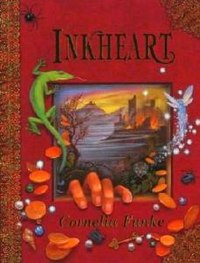
Inkheart


American cover
Book: Inhkeart by Cornelia Funke

Published: 2003

Description: Meggie lives a quiet life alone with her father, a book-binder. But her father has a deep secret-- he posseses an extraordinary magical power. One day a mysterious stranger arrives who seems linked to her father's past. Who is this sinister character and what does he want? Suddenly Meggie is involved in a breathless game of escape and intrigue as her father's life is put in danger. Will she be able to save him in time? (from Amazon.com)


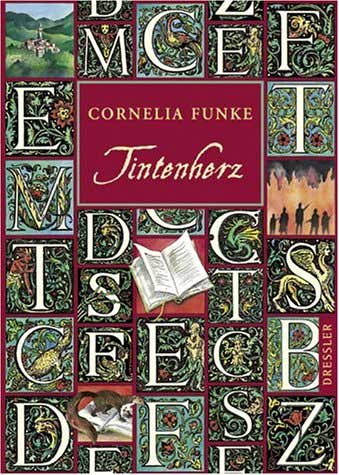
Original German cover


This was my second reading of this book, and both times I've really enjoyed it. It's absolutely wonderfully written--the descriptions are wonderful, and the characters feel amazingly real. Especially the main characters felt like real people, in that their reactions to the often dangerous situations they were thrown into wasn't, "OK, I'm going to be brave and face death to do the right thing." It was, "I'm afraid, because my life is in danger. I don't know what to do!" Many of the characters also develop throughout the book, becoming more able/willing to deal with those situations and conquer their fear of death/pain. A lot of the characters were also a lot of fun, especially Elinor. 

My absolute favorite aspect of Inkheart is the love of books that completely permeates it. Each chapter begins with a quote from a book, and books are constantly being referenced. As someone who loves books so much, I love books that portray characters with the same love. It also plays with the border between stories and reality in a lot of ways. But I will say that I also appreciated the fact that books were not shown as the ultimate solution to all problems. Books were good, perhaps even to the point of a certain amount of obsession, but characters who tried to gain strength from books failed. Books did not just solve all problems.

An extremely enjoyable, absorbing tale--well-written and well worth the time put into it.

Monday, September 3, 2012

Travels in West Africa


Book: Travels in West Africa by Mary H. Kingsley

Country: Guinea

Description: Unique perspective: Until 1893, Mary Kingsley led a secluded life in Victorian England. At age 30 however, Kingsley defied convention and arranged a trip to west Africa to collect botanical samples for a book left unfinished by her father. Such a daring adventure was unheard of for women at the time. Kingsley traveled through western and equatorial Africa and became the first European to enter parts of Gabon. Her story--as an explorer and as a woman--offers an enduring tale of adventure. Adventure writer and historian Tony Brandt sets Kingsley's Africa against the history of other European explorations of the continent and details her contributions not only to literature, but science as she collected more than 400 samples--some now extinct--of plants and insects. Handsome editions, competitively priced: Gathered together for the first time in inexpensive, accessible editions, Adventure Press Classics offer readers the opportunity to build a comprehensive library of the most adrenaline-packed tales of adventure ever written. She was the first Englishwoman and the "third Englishman," as she put it, to climb the great peak of the Cameroons. She traveled with native guides but otherwise without a man along into some of West Africa's most dangerous jungles, up its most dangerous rivers. She fought off crocodiles with a paddle, hit a leopard over the head with a pot, fell into an animal trap lined at the bottom with sharpened sticks, waded through swamps in water chin deep. Then she wrote this book, which describes her adventures in detail, as well as her discoveries as a naturalist and her observations of the Africans and their customs. She writes a brisk engaging prose and she is clearly dauntless. The book was no. 18 on the Adventure list of the 100 best adventure books. It's a wonderful read. (from amazon.com)

Country: Guinea


Time: Set in 1893

My Review: 

One of the things I enjoyed most about this book was the humor--very dry and British, and exactly how I like it. Here are a few examples: 
When you spend the day on shore and when, having exhausted the charms of the town, - a thing that usually takes from between ten minutes to a quarter of an hour, - you apply to an inhabitant for advice as to the disposal of the rest of your shore leave, you are told to “go and see the coals.”  You say you have not come to tropical islands to see a coal heap, and applying elsewhere for advice you probably get the same.  So, as you were told to “go and see the coals” when you left your ship, you do as you are bid.  These coals, the remnant of the store that was kept here for the English men-of-war, were left here when the naval station was removed.  The Spaniards at first thought of using them, and ran a tram-way from Clarence to them.  But when the tramway was finished, their activity had run out too, and to this day there the coals remain.  Now and again some one has the idea that they are quite good, and can be used for a steamer, and some people who have tried them say they are all right, and others say they are all wrong.  And so the end of it will be that some few thousand years hence there will be a serious quarrel among geologists on the strange pocket of coal on Fernando Po, and they will run up continents, and raise and lower oceans to explain them, and they will doubtless get more excitement and pleasure out of them than you can nowadays. (chapter II) 
Also:
All West African steamers have a mania for bush, and the delusion that they are required to climb trees.  The Fallaba had the complaint severely, because of her defective steering powers, and the temptation the magnificent forest, and the rapid currents, and the sharp turns of the creek district, offered her; she failed, of course - they all fail - but it is not for want of practice.  I have seen many West Coast vessels up trees, but never more than fifteen feet or so. (Chapter IV)
The one problem I had with the humor was that sometimes it was aimed at the Africans and often (but not always) came off as critical and snobbish.

The other aspect of this book that I really enjoyed were the descriptions of Africa--the various tribes and their cultures, the white society there, the traveling, and most especially the African landscape: 
The beauty of the night on Kondo Kondo was superb; the sun went down and the afterglow flashed across the sky in crimson, purple, and gold, leaving it a deep violet-purple, with the great stars hanging in it like moons, until the moon herself arose, lighting the sky long before she sent her beams down on us in this valley.  As she rose, the mountains hiding her face grew harder and harder in outline, and deeper and deeper black, while those opposite were just enough illumined to let one see the wefts and floating veils of blue-white mist upon them, and when at last, and for a short time only, she shone full down on the savage foam of the Alemba, she turned it into a soft silver mist.  Around, on all sides, flickered the fire-flies, who had come to see if our fire was not a big relation of their own, and they were the sole representatives, with ourselves, of animal life.  When the moon had gone, the sky, still lit by the stars, seeming indeed to be in itself lambent, was very lovely, but it shared none of its light with us, and we sat round our fire surrounded by an utter darkness.  Cold, clammy drifts of almost tangible mist encircled (Chapter V).  


I decided to read this book because heard that Kingsley one of the few travelers of the time who respectived African culture, and I largely found this to be true. She respected not only African culture, but also Africans themselves: "I confess I like the African on the whole, a thing I never expected to do when I went to the Coast with the idea that he was a degraded, savage, cruel brute; but that is a trifling error you soon get rid of when you know him" (Chapter XXI). Kingsley acknowledged that African culture was different than European culture, and that customs that worked in Europe might or would not work in the competeley different culture (and climate) of Africa (not even beginning to think about each unique tribe). She therefore blamed the missionary schools for a lot of the problems in West Africa (present-day Guinea) because they unsuccessfully tried to tranplant Africans into a European way of thinking and really just confused/ruiend them (morally, I mean--they were often very successful traders). At the same time, though, Kingsley out and out says that she thinks African culture is inferior to European culture and that Africans are incapable of reaching the "heights" of European culture. I don't agree (although it's not true that European culture is "best"--we have plenty of our own problems--and so there's no reason for Africans to be forced to Europeanize), but I think it shows how illogical we can all be at times. In many ways this book was extremely honestly written, and it reveals a lot about Kingsley's thought processes and biases. 

Kingsley's ideas on gender also complex. Kingsley was a white woman, alone, journeying through dangerous country, searching for scientific specimens--not exactly traditional. She makes several comments about the cluelessness of men, she seems to almost relish her freedom from a husband: "as for the husband, neither the Royal Geographical Society’s list, in their ‘Hints to Travellers,’ nor Messrs. Silver, in their elaborate lists of articles necessary for a traveller in tropical climates, make mention of husbands" (Chapter V). At the same time, though, she could be very traditional: she wore a skirt for the whole journey, and even says once that men are superior to women.


Be warned, however, that parts of the book could be boring, such as Kingsley's recommendations on creating a trade empire in British Africa.

Sunday, August 12, 2012

Sir Gawain and the Green Knight


Book: Sir Gawain and the Green Knight (anonymous)

Time: Written sometime in the late 14th century

Description: Written by an anonymous fourteenth-century poet, Sir Gawain and the Green Knight is recognized as an equal to Chaucer’s masterworks and to the great Old English poems, Beowulf included. A green-skinned knight offers the Knights of the Round Table a simple but deadly challenge—a challenge taken on by the brave Sir Gawain. A challenge that will force him to choose between his honor and his life... (from amazon.com)

I enjoyed this book, very much. Firstly, the poetry was very cool. It didn't rhyme (except for the last five lines of each stanza), but rather there were three or four words in each line that began with the same sound.

I really enjoyed the descriptions--they were very vivid. I'm not sure why that surprised me, but it did. The descriptions of the seasons and of Sir Gawain's journey were especially vivid and enjoyable for me.

This was very much a Christian book/poem throughout: Gawain is very Christian, tries hard not to sin (which (not sinning, I mean) he does a bit too much to feel realistic, but anyway. The narrator will only admit that he sinned once in the entire year that the narrative spans and, let's face it, if that were true than there wouldn't be quite as much of a need for Jesus), prays a lot. When his host's wife literally throws herself at him, he doesn't even think about doing anything with her. Good for him! He does, in the end, do something else instead, which brough up an interesting point--at the end it was decided that that sin wasn't "too big". But sin is sin, period. I loved Gawain's reaction to the realization that he'd sinned, though--he admits it and repents, straight up. From Gawain I just very much got the feel of someone trying hard to strive for God and His perfection. Also loved his faith: almost always he was determined to do what was right, no matter what the consequences might be. 

Overall, this book had a great Christian world-view and was a very enjoyable read.

Wednesday, July 25, 2012

Persuasion


Firstly, may I begin by apologizing for my long silence? Don't worry, I haven't stopped reading, by any stretch of the imagination, but my reading time has mostly been snatches of time before work and during meals, as well as for most of Sunday afternoon (as part of my Sabbath). But this curtailed reading time has meant that I haven't been doing much writing about what I've read.

Anyway, thanks for your patience! Here's a review of a book that I finished back at the beginning of the month.

Book: Persuasion by Jane Austen

Time: set in the years 1814 and 1815

Description: Superb novel, autumnal and mellow in tone, concerns the lives and loves of the Elliot family and their friends and relatives, in particular the thwarted romance between Anne Elliot (Austen's sweetest, most appealing heroine) and Captain Frederick Wentworth. Finely drawn characters, gentle satire and wonderful recreation of genteel life in the English countryside. (from amazon.com)

I really enjoyed this book. It was the first book that I've read in a while where I was excited for the end to find out what happened and how it ended, not simply to reach the end.

I really liked Anne, the main character. She was a character I could really relate to and like from beginning to end.  I thought she handled the whole situation honorably, as did Captain Wentworth. It was a welcome change. I really felt for Anne, and wanted things to turn out well. Man, her family was horrible! How did she turn out so well??

I found all the characters and situations realistic and engaging. I'll admit, though, that I really enjoy scenes that play on awkwardness, either because of (unknown) social norms or because of emotional undercurrents, and there was a lot of the second, especially, in this book.

It was the shortest of Austen's books that I've read so far, and also, I thought, the easiest (but maybe I'm just getting used to her style). It was possibly the book that I've enjoyed the most as well (although Emma might also claim that distinction).

Monday, July 2, 2012

Journey Through Time

I've decided to challenge myself with another goal as well: to read a book set in and published during every time period between the year 0 and the present. My time periods are honestly completely subjective, and have nothing to do with actual historical periods; I just divided earlier years, with less books, into hundred-year blocks, and made the time blocks smaller as books became more common.

As with the Read Around the World challenge, this challenge isn't about finishing by a certain time so much as it is about the journey: reading books from all different time periods, seeing how other people thought and did things.