The Evangelium has not abrogated legends; it has hallowed them, especially the "happy ending." The Christian has still to work, with mind as well as body, to suffer, hope, and die; but he may now perceive that all his bents and faculties have a purpose, which can be redeemed. So great is the bounty with which he has been treated that he may now, perhaps, fairly dare to guess that in Fantasy he may actually assist in the effoliation and multiple enrichment of creation. All tales may come true; and yet, at the last, redeemed, they may be as like and unlike the forms that we give them as Man, finally redeemed, will be like and unlike the fallen that we know.~ J. R. R. Tolkien
Monday, October 15, 2012
J. R. R. Tolkien Quote
In my best moments, when I'm most connected to God, this is why I read:

Sunday, October 7, 2012
The Once and Future King

Book: The Once and Future King by T. H. White
Published: 1958
Description: T.H. White's masterful retelling of the saga of King Arthur is a fantasy classic as legendary as Excalibur and Camelot, and a poignant story of adventure, romance, and magic that has enchanted readers for generations. (from Amazon.com)
I had heard great things about this book, from many people, but I was very disappointed when I read it.
But I'll start at the beginning. This book was written as a retelling of the Arthur myth, based mostly on Sir Thomas Malory's Le Morte D'Arthur. It's divided into four books: Sword in the Stone, The Question of Air and Darkness, The Ill-Made Knight, and The Candle in the Wind. These books are normally combined, but they were also written separately, and each could stand alone.
Sword in the Stone was great. It was absolutely my favorite. It had a very dry humor (my favorite!), and it was very satirical but in a rather kind way. Wart was alright--not the brightest, perhaps, but brave and honest. He had good adventures, and him turning into animals was nice (some animals were better than others). Merlyn absolutely made the book--he was a great character! He was extraordinarily quirky, and he lived backwards in time rather than forwards, so he was always saying things about the future (which, of course, was the past to him). Most of the other characters were fun and entertaining as well, like King Pellinore, Robin Wood, and the Questing Beast. White also went into a lot of detail about medieval life, which benefitted the book a lot.
The other three books were not so good. Most of The Question of Air and Darkness dealt with the witch Morgeuse and her children (Gawaine, Agravaine, Gaheris, and Gareth). They were a very twisted family, and I did not enjoy seeing their perspective one bit. The Ill-Made Knight was all about Lancelot and Guinever, and the search for the Grail. Arthur came across fairly well in this book, as a wise, merciful king devoted to doing what was right for his kingdom, but no one else really did. The Candle in the Wind was depressing, and not in a good way. I know there is evil and death in the world, and it is awful, but this book seemed to be mostly about despair and how nothing good will ever last, and that is not the Christian message.
My main problem with this book was that it tried to tell a very Christian story, but take God out of it. The result was a book where the message seemed to be that we should try to do good, but we probably won't succeed, and if we do then it won't last. I suppose that's what the world turns into when you don't believe in God. There were also numerous references to evolution, especially in Sword in the Stone when Wart was turning into animals; although that doesn't bother me, it could bother some. Perhaps as a nod to the Christianity of the British Isles at the time, some characters referred to their Christianity and taught others about it, but it was a Christianity without God and an understanding of Him.
The reason that I included this book in my Journey Through Time series/challenge was because this was a book very much influenced by its time--that is, a world still recovering from World War II and in the midst of the Cold War. (This was also the time when biologists were refining their ideas on evolution to be the more refined ones of today, so perhaps that's why there are so many evolution references) White's ideas of war were very much shaped around those events, and around teaching children the wrongs of war. White wasn't against war, but he was against ever starting a war. Merlyn (who had lived through World War II) taught Arthur never to start war, and to try to redirect the might of the knights into something good and pure (chivalry and the Round Table). He referenced World War II, condemned going to war to convince others you're right and building up weapons to stay at the same level as your enemy, and turned Wart into an ant so he could see what it was like to live in a society with no free will or thought.
My main problem with this book was that it tried to tell a very Christian story, but take God out of it. The result was a book where the message seemed to be that we should try to do good, but we probably won't succeed, and if we do then it won't last. I suppose that's what the world turns into when you don't believe in God. There were also numerous references to evolution, especially in Sword in the Stone when Wart was turning into animals; although that doesn't bother me, it could bother some. Perhaps as a nod to the Christianity of the British Isles at the time, some characters referred to their Christianity and taught others about it, but it was a Christianity without God and an understanding of Him.
The reason that I included this book in my Journey Through Time series/challenge was because this was a book very much influenced by its time--that is, a world still recovering from World War II and in the midst of the Cold War. (This was also the time when biologists were refining their ideas on evolution to be the more refined ones of today, so perhaps that's why there are so many evolution references) White's ideas of war were very much shaped around those events, and around teaching children the wrongs of war. White wasn't against war, but he was against ever starting a war. Merlyn (who had lived through World War II) taught Arthur never to start war, and to try to redirect the might of the knights into something good and pure (chivalry and the Round Table). He referenced World War II, condemned going to war to convince others you're right and building up weapons to stay at the same level as your enemy, and turned Wart into an ant so he could see what it was like to live in a society with no free will or thought.
Thursday, October 4, 2012
A Concise History of China
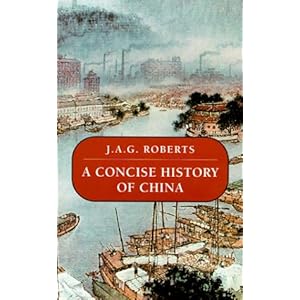
Country: China

Description: The centuries-long complexity of China's political experience, the richness of its culture, and the drama of its economic unfolding are the hallmarks of this short but sweeping history. China's own history is entwined with its response to the West in a rich tapestry depicting its peoples, rulers, and society. More than a nuanced history of a vast continent, this study is sensitive to the multifaceted and changing interpretations of China that have been offered over the years.
In this overarching book, J. A. G. Roberts refers to recent archeological finds--the caches of bronze vessels found at Sanxingdui--and to new documentary reevaluations--the reassessment of Manchu documentation. The first half of the book provides an up-to-date interpretation of China's early and imperial history, while the second half concentrates on the modern period and provides an interpretive account of major developments--the impact of Western imperialism, the rise of Chinese Communism, and the record of the People's Republic of China since 1949. (from amazon.com)
In this overarching book, J. A. G. Roberts refers to recent archeological finds--the caches of bronze vessels found at Sanxingdui--and to new documentary reevaluations--the reassessment of Manchu documentation. The first half of the book provides an up-to-date interpretation of China's early and imperial history, while the second half concentrates on the modern period and provides an interpretive account of major developments--the impact of Western imperialism, the rise of Chinese Communism, and the record of the People's Republic of China since 1949. (from amazon.com)
This book was certainly very concise--4,000 years of Chinese history in 300 pages! For all that, however, it was very informative, and I do feel as if I now have a good overview of Chinese history, especially politics. I do wish Roberts had focused more on social changes as well as politics, simply because I find that more interesting but I also know that those parts of history are less clear-cut and less documented.
The other problem with this being such a short history was that it almost raised more questions than it answered. So many interesting people appeared quickly and then were gone, like the Empress Wu, the only empress in Chinese history, or Ding Ling, a writer in early communism. It also, at least for me, raised bigger questions about my view of Chinese culture and history, as a Westerner and as a Christian. In that sense, it was a book that led to a lot of reflection during and after I was reading.
Saturday, September 29, 2012
Inkheart
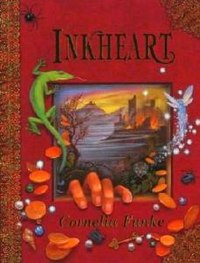 |
| American cover |
Book: Inhkeart by Cornelia Funke
Published: 2003
Description: Meggie lives a quiet life alone with her father, a book-binder. But her father has a deep secret-- he posseses an extraordinary magical power. One day a mysterious stranger arrives who seems linked to her father's past. Who is this sinister character and what does he want? Suddenly Meggie is involved in a breathless game of escape and intrigue as her father's life is put in danger. Will she be able to save him in time? (from Amazon.com)
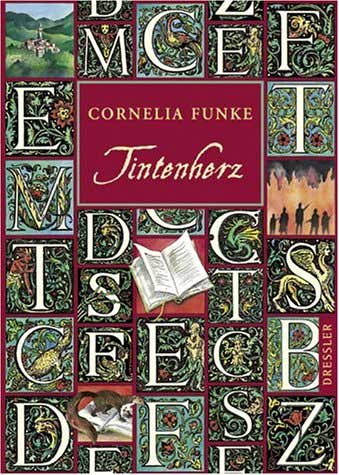 |
| Original German cover |
This was my second reading of this book, and both times I've really enjoyed it. It's absolutely wonderfully written--the descriptions are wonderful, and the characters feel amazingly real. Especially the main characters felt like real people, in that their reactions to the often dangerous situations they were thrown into wasn't, "OK, I'm going to be brave and face death to do the right thing." It was, "I'm afraid, because my life is in danger. I don't know what to do!" Many of the characters also develop throughout the book, becoming more able/willing to deal with those situations and conquer their fear of death/pain. A lot of the characters were also a lot of fun, especially Elinor.
My absolute favorite aspect of Inkheart is the love of books that completely permeates it. Each chapter begins with a quote from a book, and books are constantly being referenced. As someone who loves books so much, I love books that portray characters with the same love. It also plays with the border between stories and reality in a lot of ways. But I will say that I also appreciated the fact that books were not shown as the ultimate solution to all problems. Books were good, perhaps even to the point of a certain amount of obsession, but characters who tried to gain strength from books failed. Books did not just solve all problems.
An extremely enjoyable, absorbing tale--well-written and well worth the time put into it.
An extremely enjoyable, absorbing tale--well-written and well worth the time put into it.
Thursday, September 27, 2012
Snow Flower and the Secret Fan

Book: Snow Flower and the Secret Fan by Lisa See
Country: China

Description: A language kept a secret for a thousand years forms the backdrop for an unforgettable novel of two Chinese women whose friendship and love sustains them through their lives.
This absorbing novel – with a storyline unlike anything Lisa See has written before – takes place in 19th century China when girls had their feet bound, then spent the rest of their lives in seclusion with only a single window from which to see. Illiterate and isolated, they were not expected to think, be creative, or have emotions. But in one remote county, women developed their own secret code, nu shu – "women's writing" – the only gender-based written language to have been found in the world. Some girls were paired as "old-sames" in emotional matches that lasted throughout their lives. They painted letters on fans, embroidered messages on handkerchiefs, and composed stories, thereby reaching out of their windows to share their hopes, dreams, and accomplishments.
An old woman tells of her relationship with her "old-same," their arranged marriages, and the joys and tragedies of motherhood—until a terrible misunderstanding written on their secret fan threatens to tear them apart. With the detail and emotional resonance of Memoirs of a Geisha ,Snow Flower and the Secret Fan delves into one of the most mysterious and treasured relationships of all time—female friendship. (from lisasee.com)
My first descriptive word for this book would be sad or poignant. It was about the lives of women in China--with their feet bound and in a strictly traditional, patriarchal society, they had very little freedom. Marriages were arranged, girls were thought of as practically worthless. The narrator, Lily, describes her life, from her girlhood and foot-binding, her marriage, and finally her old age. The novel certainly revealed a dark side of Chinese society that I'd never thought about before. I suppose every society has its dark side, but I still found it horrible. Perhaps it was because it was occurring in another culture, and I fell more free to criticize it, or because I haven't grown accustomed to its evils.
One of the major themes in the novel was food-binding. It was something that all the women in the novel accepted despite the pain--not only to themselves as girls, but also of having to do that to their daughters when they were 6 or 7. But what about the things we do today for beauty--anorexia, bulimia, plastic surgery.
More than anything, the major focus of the novel, and certainly Lily's retelling of her life, was her friendship with Snow Flower. Typically in China, or at least in the area being described in the novel, a woman would have a group of friends (a group of sworn sisters) that would change with the different stages of her life--one for girlhood, one for old age, and so on. But Lily and Snow Flower are laotongs, which means that they will be friends for life, able to send each other letters and gifts at all ages, and meet every year at the same place.
An emotional roller coaster, but very good. The emotions of this book were very strong, but ultimately too pessimistic for me. Perhaps I've just lived a lucky life, but life isn't all sadness. Or maybe it's because I have a wonderful God who gives me joy all the time!
Monday, September 3, 2012
Travels in West Africa

Book: Travels in West Africa by Mary H. Kingsley
Country: Guinea
Description: Unique perspective: Until 1893, Mary Kingsley led a secluded life in Victorian England. At age 30 however, Kingsley defied convention and arranged a trip to west Africa to collect botanical samples for a book left unfinished by her father. Such a daring adventure was unheard of for women at the time. Kingsley traveled through western and equatorial Africa and became the first European to enter parts of Gabon. Her story--as an explorer and as a woman--offers an enduring tale of adventure. Adventure writer and historian Tony Brandt sets Kingsley's Africa against the history of other European explorations of the continent and details her contributions not only to literature, but science as she collected more than 400 samples--some now extinct--of plants and insects. Handsome editions, competitively priced: Gathered together for the first time in inexpensive, accessible editions, Adventure Press Classics offer readers the opportunity to build a comprehensive library of the most adrenaline-packed tales of adventure ever written. She was the first Englishwoman and the "third Englishman," as she put it, to climb the great peak of the Cameroons. She traveled with native guides but otherwise without a man along into some of West Africa's most dangerous jungles, up its most dangerous rivers. She fought off crocodiles with a paddle, hit a leopard over the head with a pot, fell into an animal trap lined at the bottom with sharpened sticks, waded through swamps in water chin deep. Then she wrote this book, which describes her adventures in detail, as well as her discoveries as a naturalist and her observations of the Africans and their customs. She writes a brisk engaging prose and she is clearly dauntless. The book was no. 18 on the Adventure list of the 100 best adventure books. It's a wonderful read. (from amazon.com)
Country: Guinea

Time: Set in 1893
My Review:
One of the things I enjoyed most about this book was the humor--very dry and British, and exactly how I like it. Here are a few examples:
When you spend the day on shore and when, having exhausted the charms of the town, - a thing that usually takes from between ten minutes to a quarter of an hour, - you apply to an inhabitant for advice as to the disposal of the rest of your shore leave, you are told to “go and see the coals.” You say you have not come to tropical islands to see a coal heap, and applying elsewhere for advice you probably get the same. So, as you were told to “go and see the coals” when you left your ship, you do as you are bid. These coals, the remnant of the store that was kept here for the English men-of-war, were left here when the naval station was removed. The Spaniards at first thought of using them, and ran a tram-way from Clarence to them. But when the tramway was finished, their activity had run out too, and to this day there the coals remain. Now and again some one has the idea that they are quite good, and can be used for a steamer, and some people who have tried them say they are all right, and others say they are all wrong. And so the end of it will be that some few thousand years hence there will be a serious quarrel among geologists on the strange pocket of coal on Fernando Po, and they will run up continents, and raise and lower oceans to explain them, and they will doubtless get more excitement and pleasure out of them than you can nowadays. (chapter II)
Also:
All West African steamers have a mania for bush, and the delusion that they are required to climb trees. The Fallaba had the complaint severely, because of her defective steering powers, and the temptation the magnificent forest, and the rapid currents, and the sharp turns of the creek district, offered her; she failed, of course - they all fail - but it is not for want of practice. I have seen many West Coast vessels up trees, but never more than fifteen feet or so. (Chapter IV)
The one problem I had with the humor was that sometimes it was aimed at the Africans and often (but not always) came off as critical and snobbish.
The other aspect of this book that I really enjoyed were the descriptions of Africa--the various tribes and their cultures, the white society there, the traveling, and most especially the African landscape:
The beauty of the night on Kondo Kondo was superb; the sun went down and the afterglow flashed across the sky in crimson, purple, and gold, leaving it a deep violet-purple, with the great stars hanging in it like moons, until the moon herself arose, lighting the sky long before she sent her beams down on us in this valley. As she rose, the mountains hiding her face grew harder and harder in outline, and deeper and deeper black, while those opposite were just enough illumined to let one see the wefts and floating veils of blue-white mist upon them, and when at last, and for a short time only, she shone full down on the savage foam of the Alemba, she turned it into a soft silver mist. Around, on all sides, flickered the fire-flies, who had come to see if our fire was not a big relation of their own, and they were the sole representatives, with ourselves, of animal life. When the moon had gone, the sky, still lit by the stars, seeming indeed to be in itself lambent, was very lovely, but it shared none of its light with us, and we sat round our fire surrounded by an utter darkness. Cold, clammy drifts of almost tangible mist encircled (Chapter V).
I decided to read this book because heard that Kingsley one of the few travelers of the time who respectived African culture, and I largely found this to be true. She respected not only African culture, but also Africans themselves: "I confess I like the African on the whole, a thing I never expected to do when I went to the Coast with the idea that he was a degraded, savage, cruel brute; but that is a trifling error you soon get rid of when you know him" (Chapter XXI). Kingsley acknowledged that African culture was different than European culture, and that customs that worked in Europe might or would not work in the competeley different culture (and climate) of Africa (not even beginning to think about each unique tribe). She therefore blamed the missionary schools for a lot of the problems in West Africa (present-day Guinea) because they unsuccessfully tried to tranplant Africans into a European way of thinking and really just confused/ruiend them (morally, I mean--they were often very successful traders). At the same time, though, Kingsley out and out says that she thinks African culture is inferior to European culture and that Africans are incapable of reaching the "heights" of European culture. I don't agree (although it's not true that European culture is "best"--we have plenty of our own problems--and so there's no reason for Africans to be forced to Europeanize), but I think it shows how illogical we can all be at times. In many ways this book was extremely honestly written, and it reveals a lot about Kingsley's thought processes and biases.
Kingsley's ideas on gender also complex. Kingsley was a white woman, alone, journeying through dangerous country, searching for scientific specimens--not exactly traditional. She makes several comments about the cluelessness of men, she seems to almost relish her freedom from a husband: "as for the husband, neither the Royal Geographical Society’s list, in their ‘Hints to Travellers,’ nor Messrs. Silver, in their elaborate lists of articles necessary for a traveller in tropical climates, make mention of husbands" (Chapter V). At the same time, though, she could be very traditional: she wore a skirt for the whole journey, and even says once that men are superior to women.
Be warned, however, that parts of the book could be boring, such as Kingsley's recommendations on creating a trade empire in British Africa.
Sunday, August 26, 2012
The Fingerprint of God
Book: The Fingerprint of God by Hugh Ross
Description: Dr. Hugh Ross, astromomer, tells the fascinating story of how the latest research into origins not only has sealed the case for divine creation, but has revealed the identity of the Creator Himself. (from Amazon.com)
Overall, I found this book to be a very worthwhile read. Ross attempts to prove with science why God must have created the universe and life, rather than seeing science and religion as polar opposites--a refreshing change, I must say. He also discusses, much more briefly, reasons why Scripture does not actually conflict with the scientific evidence for how the universe was created.
Honestly, those parts of the books were the parts that I enjoyed the most. I love biology, but I get sick of the assumptions that evolution and Creation are two mutually exclusive ideas. They are not. After all,
it is also safe to assume that physical evidence will not lie, because God created the evidence and God can't lie (although misinterpretations could of course still happen). Ross even goes so far as to argue that one can only reach the fullest understanding of God through a combined knowledge of Scripture and nature.
I will admit, however, that I had some problems with this book. The first half at least of the book was about astrophysical proof for God, and was written in a way that I couldn't understand most of the proofs or why they were so impressive. Too much math and quantum mechanics for me! So I didn't exactly feel convinced by the end of it.
★★★★
My favorite quote: "One further consideration [of the reasons for creation] from an altogether different perspective concerns the nature of creativity itself. Observe any skilled sculptor, painter, or poet, a craftsman of any kind. Observe the painstaking, yet joyful labor poured into each object of his design. Examine the creation on any scale, from a massive galaxy to the interior of an atom, from a whale to an amoeba. The splendor of each item, its beauty of form as well as of function, speaks not of instantaneous mass production, but rather of time and attention to detail, of infinite care and delight. Such delight is expressed throughout Genesis 1 in the oft-repeated statement, 'And God saw that it was good.'" (160)
Thursday, August 23, 2012
Great Quote
I ran across this quote in The Craft of Research, by Wayne C. Booth, Gregory G. Colomb, and Joseph M. Williams:
No place is more filled with imagined voices than a library or lab. Whether you read a book or a lab report, you silently converse with its writer--and through her with everyone else she has read. In fact, every time you go to a written source of information, you join a conversation between writers and readers that began more than five thousand years ago. (p. 16)And that pretty much sums up why I read.
Sunday, August 19, 2012
Is God a Moral Monster?

Book: Is God a Moral Monster?: Making Sense of the Old Testament God by Paul Copan
Description: A recent string of popular-level books written by the New Atheists have leveled the accusation that the God of the Old Testament is nothing but a bully, a murderer, and a cosmic child abuser. This viewpoint is even making inroads into the church. How are Christians to respond to such accusations? And how are we to reconcile the seemingly disconnected natures of God portrayed in the two testaments?
In this timely and readable book, apologist Paul Copan takes on some of the most vexing accusations of our time, including:
God is arrogant and jealous
God punishes people too harshly
God is guilty of ethnic cleansing
God oppresses women
God endorses slavery
Christianity causes violence
and more
Copan not only answers God's critics, he also shows how to read both the Old and New Testaments faithfully, seeing an unchanging, righteous, and loving God in both.
This book was very enlightening for me. The seeming differences between the God of the Old Testament, who at the very least seems much more legalistic and violent than the God of the New Testament, are something that I've had questions about for a long time. I was therefore pretty excited about reading this book, and I wasn't disappointed.
Copan did a very good job explaining why God seems the way that He did in the Old Testament. He mostly focused on the Law and explaining how and why they came to be. He also talked, surprisingly a lot, about how those laws apply to us today. I'm not saying Copan calls for us to follow the Law today, because he definitely doesn't. Instead, he examines what aspects of God made Him create the Law the way He did. One example that really struck me was the food laws, about unclean and clean animals. Copan argued that these laws were so all-encompassing to remind the Israelites that God should be everywhere in their life. A reminder we could all use, huh?
Although I have no background in Biblical scholarship or anything of that kind, I found Is God a Moral Monster? easy to read and understand. Copan's knowledge of and use of Scripture was also extremely impressive. My one complaint was that Copan's chapters became repetitive at times, as he seemed to be making the same point over and over. But it was a small problem for me as a reader, and I would absolutely recommend this book to anyone who's interested in the topic.
Sunday, August 12, 2012
Sir Gawain and the Green Knight

Book: Sir Gawain and the Green Knight (anonymous)
Time: Written sometime in the late 14th century
Description: Written by an anonymous fourteenth-century poet, Sir Gawain and the Green Knight is recognized as an equal to Chaucer’s masterworks and to the great Old English poems, Beowulf included. A green-skinned knight offers the Knights of the Round Table a simple but deadly challenge—a challenge taken on by the brave Sir Gawain. A challenge that will force him to choose between his honor and his life... (from amazon.com)
I enjoyed this book, very much. Firstly, the poetry was very cool. It didn't rhyme (except for the last five lines of each stanza), but rather there were three or four words in each line that began with the same sound.
I really enjoyed the descriptions--they were very vivid. I'm not sure why that surprised me, but it did. The descriptions of the seasons and of Sir Gawain's journey were especially vivid and enjoyable for me.
This was very much a Christian book/poem throughout: Gawain is very Christian, tries hard not to sin (which (not sinning, I mean) he does a bit too much to feel realistic, but anyway. The narrator will only admit that he sinned once in the entire year that the narrative spans and, let's face it, if that were true than there wouldn't be quite as much of a need for Jesus), prays a lot. When his host's wife literally throws herself at him, he doesn't even think about doing anything with her. Good for him! He does, in the end, do something else instead, which brough up an interesting point--at the end it was decided that that sin wasn't "too big". But sin is sin, period. I loved Gawain's reaction to the realization that he'd sinned, though--he admits it and repents, straight up. From Gawain I just very much got the feel of someone trying hard to strive for God and His perfection. Also loved his faith: almost always he was determined to do what was right, no matter what the consequences might be.
Overall, this book had a great Christian world-view and was a very enjoyable read.
Subscribe to:
Posts (Atom)