Sunday, November 25, 2012

The Craft of Research


Book: The Craft of Research by Wayne C. Booth, Gregory C. Colomb, and Joseph M. Williams

Description: With more than 400,000 copies now in print, The Craft of Research is the unrivaled resource for researchers at every level, from first-year undergraduates to research reporters at corporations and government offices.
 
Seasoned researchers and educators Gregory G. Colomb and Joseph M. Williams present an updated third edition of their classic handbook, whose first and second editions were written in collaboration with the late Wayne C. Booth. The Craft of Research explains how to build an argument that motivates readers to accept a claim; how to anticipate the reservations of readers and to respond to them appropriately; and how to create introductions and conclusions that answer that most demanding question, “So what?”
 
The third edition includes an expanded discussion of the essential early stages of a research task: planning and drafting a paper. The authors have revised and fully updated their section on electronic research, emphasizing the need to distinguish between trustworthy sources (such as those found in libraries) and less reliable sources found with a quick Web search. A chapter on warrants has also been thoroughly reviewed to make this difficult subject easier for researchers
 
Throughout, the authors have preserved the amiable tone, the reliable voice, and the sense of directness that have made this book indispensable for anyone undertaking a research project. (from Amazon.com)

For a book with such an uninteresting-sounding title (although I do love research), this was a very interesting read. The authors' passion for research, especially well-done research, really shines through. They also point how vital research is to society--I've never seen the earth from space, so I don't know that it's round, but I trust the reliable people who've done research on the topic and tell me that it is. If people blatantly deceive with their research, society will suffer.

Their work also very much influenced by the that everything we do is really standing on work that others have done before us. Just really cool admission, and something I love to think about.

Probably the thing that I enjoyed the most about this book was that the authors' characters really came through--it wasn't just a bland "An introduction should have..." kind of book, but rather an engaging, witty work about how to really think about your own and others' research.

Thursday, November 22, 2012

Parzival


Book: Parzival by Sir Wolfram von Eschenbach

Country: Germany


Written: around 1197-1215

Description: Composed in the early thirteenth century, Wolfram von Eschenbach's Parzival is the re-creation and completion of the story left unfinished by its initiator Chretien de Troyes. It follows Parzival from his boyhood and career as a knight in the court of King Arthur to his ultimate achievement as King of the Temple of the Grail, which Wolfram describes as a life-giving Stone. As a knight serving the German nobility in the imperial Hohenstauffen period, the author was uniquely placed to describe the zest and colour of his hero's world, with dazzling depictions of courtly luxury, jousting and adventure. Yet this is not simply a tale of chivalry, but an epic quest for spiritual education, as Parzival must conquer his ignorance and pride and learn humility before he can finally win the Holy Grail. (from Amazon.com)

This was a really wonderful poem. Parzival's story is a great story of someone growing from an ignorant boy to an arrogant young man to a humble Christian. There were several scenes that I absolutely loved: when Parzival was so love-sick for his wife that he couldn't fight (there was a beautiful description of love!), and when Parzival went to the hermit and talked with him about God and ultimately gave his life to Him. Many of the objections Parzival raised to the existence of God are questions that people still have. It was good to hear these questions in a story written almost 1,000 years ago. We are not alone in the questions we have. Parzival's story is the story of many of us.

This may be silly, but one of the things that surprised me in reading this was how much this epic was like more modern works of fiction. The descriptions were very detailed at times, and they definitely conjured up a world for me. There was also an amazing, and unexpected, emotional depth in this story. Perhaps they resonated with me so well because so many of these emotions were being ultimately constrained and dealt with in the context of the overarching Christianity of most of the characters.

There were a few aspects of Parzival that I didn't like. For some reason, however, less than half of this epic is actually about Parzival. There are two chapters about his father, Gachmuret, and the rest is about Gawain--who was cool and all, but Parzival was better. Also, most of the characters see baptism as the ultimate sign of a relationship with God, which obviously isn't true. So do just keep that in mind.

Overall, however, this was a wonderful epic poem, with an inspiring plot and realistic Christian characters.

Saturday, November 10, 2012

The Neverending Story


Book: The Neverending Story by Michael Ende

Description: Shy, awkward Bastian is amazed to discover that he has become a character in the mysterious book he is reading and that he has an important mission to fulfill. (from Amazon.com)

I really enjoyed this story. In many ways it felt like reality-- the fact that the narrator acknowledged all the other stories that were woven into Bastian's, the emotional turmoil that Bastian especially went through, and the emotional truths that were woven into the story. Ende did a fantastic job with the world-building--Fantasia felt like a real place, even though it was a fantasy world (something that even the story acknowledged), I really enjoyed all the small details like the hint that Shakespeare came to Fantasia, and all the peoples and places that he created were very cool. Overall, I think that feel of Fantasia was the feel of a world in an epic poem like Parsival--people are either good or bad, people do great deeds, the world seems magical and the main character must go through some trial of character (although it also acknowledged the real world through Bastian's early experiences, and really played with the idea of books versus reality. In that regard it really reminded me of Inkheart). The play between fiction and reality was very well-done and mind-boggling.

Although I didn't realize this until almost the last page of the book, I think that the main reason I enjoyed it so much was because The Neverending Story is an allegory for the Christian life and a Christian's relationship with fantasy and fiction in general. The main themes are the invasion of the (fantasy) world with nothingness and staying true to your self. Here I don't mean the stereoytpical sort of "stay true to yourself" advice that people give at graduations or whatever. Throughout the story Bastian wishes that he could be more and more like his idea of a 'perfect' boy (i.e. handsome, without fear, physically strong, etc.), but as his wishes are fulfilled he forgets about how he was before his wish and becomes more and more arrogant and self-centered. You do not stay true to yourself by seeking to fulfill your shallow, often societally-driven wishes, but when you realize who you truly are--a child of God, created to love others and God and be His hands and feet--and seek to stay true to who you are. Ende is not so explicit, and God is never mentioned, nor is there an obvious God figure such as Aslan in The Chronicles of Narnia. Perhaps that is why this book isn't a widely-acknowledged Christian allegory, like some other novels, and still read and enjoyed by plenty of non-Christians.

Tuesday, October 23, 2012

A Matter of Days


Book: A Matter of Days by Hugh Ross

Description: An old-earth view takes on the challenges of young-earth proponents through a study of history, Scripture, and nature-and a testable creation model. (from Amazon.com)

This was a really good book. I found it thought-provoking and well-reasoned. It's about reasons, both Biblical and scientific, to believe in long creation days. By long creation days Ross meant "days" representing epochs rather than literal 24-hour days. Also focused on fostering reconciliation between people who believe in long vs. short (24-hour) creation days.

I would highly recommend this book to anyone curious about creationism, of any kind. It was much better and more accessible than Fingerprint of God, another Hugh Ross book--there was much, much less math, and all the science he uses as evidence is much better explained. There was also nothing theologically objectionable about this book--Hugh used just as much Biblical evidence to support his claims as scientific, if not more. He assumes that the Bible is absolutely true--every single word. It's an amazing point to start from. (There are some cool Bible verses that support current science!)


As is probably obvious by now, I do not believe in creation taking place in 6 24-hour days. I believe that evolution has happened in the past, and to some extent is happening in the present day. Why? Firstly, evolution is something that is happening, according to science, and it's something that scientists have figured out to a decent amount. Life does not stay the same. Why would God create a world that seemed to be billions of years old, where evolution appeared to be happening and have been happening for billions of years, if that wasn't true? That would be lying, and God doesn't lie. Obviously not all of science is right, but evolution is something that has stood up to tests for over a hundred years and been tested by literally millions of scientists. I think it's reasonable to accept that it has happened and is happening, at least to some extent.

Please don't get me wrong--I absolutely believe in God, specifically the God of Christianity who sent His son to die for our sins. I just also believe that evolution is perfectly compatible with Christianity and the God of the Bible. There are a lot of holes in the theory of evolution as it's argued by the scientific community in general. It continues to argue that evolution is a purely random process, when mathematics show that the chances of that, and of life evolving in only 3 billion years, are so unbelievable miniscule. It continues to argue that evolution is a purely random process, when all of life seems to have been preparing earth for humans to live there: the fact that water is exactly perfect to support life (for instance being lighter frozen, allowing warmer water to stay protected from the colder temperatures and therefore allowing life to live in it); the asteroid that wiped out the dinosaurs, allowing humans to evolve from the mammals of the time; cyanobacteria evolving photosynthesis, which creates oxygen as a byproduct and eventually led to the evolution of creatures that need oxygen to breathe (like us); the fact that life has always shows a tendency to become larger and larger. There's also so much that evolution can't explain about life itself; all of the important evolutionary 'innovations' (the origin of life, having multiple cells working together, moving from the ocean to land, flight) are things where scientists can clearly see the stages, but are completely incapable of figuring out why or how the first stage led to the second one. To me, that points to God.

The other aspect of evolution that, to me, points to God is how evolution happens. There's a lot of talk about natural selection in many discussions of evolution, but the truth is that, at least in the scientific community, most scientists today believe that random chance is the single largest driving factor of most evolution. The reason most populations that are separated from each other become so different as to become separate species is not because of natural selection leading to different adaptations; it's because of randomness in their environment (like a flood that wipes out half of the population) or their genes (a mutation, or purely in which genes get passed on and which don't) that is the reason that most populations become different enough to be seen as different species. Except, of course, that as a Christian I believe that nothing is random. God has His hand in everything, and everything happens for a reason. All of those 'random' occurrences in evolution are really God, shaping life to become how He wants it.

Monday, October 15, 2012

J. R. R. Tolkien Quote

In my best moments, when I'm most connected to God, this is why I read:
The Evangelium has not abrogated legends; it has hallowed them, especially the "happy ending." The Christian has still to work, with mind as well as body, to suffer, hope, and die; but he may now perceive that all his bents and faculties have a purpose, which can be redeemed. So great is the bounty with which he has been treated that he may now, perhaps, fairly dare to guess that in Fantasy he may actually assist in the effoliation and multiple enrichment of creation. All tales may come true; and yet, at the last, redeemed, they may be as like and unlike the forms that we give them as Man, finally redeemed, will be like and unlike the fallen that we know.~ J. R. R. Tolkien

Sunday, October 7, 2012

The Once and Future King


Book: The Once and Future King by T. H. White

Published: 1958

Description: T.H. White's masterful retelling of the saga of King Arthur is a fantasy classic as legendary as Excalibur and Camelot, and a poignant story of adventure, romance, and magic that has enchanted readers for generations. (from Amazon.com)

I had heard great things about this book, from many people, but I was very disappointed when I read it.

But I'll start at the beginning. This book was written as a retelling of the Arthur myth, based mostly on Sir Thomas Malory's Le Morte D'Arthur. It's divided into four books: Sword in the Stone, The Question of Air and Darkness, The Ill-Made Knight, and The Candle in the Wind. These books are normally combined, but they were also written separately, and each could stand alone. 

Sword in the Stone was great. It was absolutely my favorite. It had a very dry humor (my favorite!), and it was very satirical but in a rather kind way. Wart was alright--not the brightest, perhaps, but brave and honest. He had good adventures, and him turning into animals was nice (some animals were better than others). Merlyn absolutely made the book--he was a great character! He was extraordinarily quirky, and he lived backwards in time rather than forwards, so he was always saying things about the future (which, of course, was the past to him). Most of the other characters were fun and entertaining as well, like King Pellinore, Robin Wood, and the Questing Beast. White also went into a lot of detail about medieval life, which benefitted the book a lot.

The other three books were not so good. Most of The Question of Air and Darkness dealt with the witch Morgeuse and her children (Gawaine, Agravaine, Gaheris, and Gareth). They were a very twisted family, and I did not enjoy seeing their perspective one bit. The Ill-Made Knight was all about Lancelot and Guinever, and the search for the Grail. Arthur came across fairly well in this book, as a wise, merciful king devoted to doing what was right for his kingdom, but no one else really did. The Candle in the Wind was depressing, and not in a good way. I know there is evil and death in the world, and it is awful, but this book seemed to be mostly about despair and how nothing good will ever last, and that is not the Christian message.

My main problem with this book was that it tried to tell a very Christian story, but take God out of it. The result was a book where the message seemed to be that we should try to do good, but we probably won't succeed, and if we do then it won't last. I suppose that's what the world turns into when you don't believe in God. There were also numerous references to evolution, especially in Sword in the Stone when Wart was turning into animals; although that doesn't bother me, it could bother some. Perhaps as a nod to the Christianity of the British Isles at the time, some characters referred to their Christianity and taught others about it, but it was a Christianity without God and an understanding of Him.


The reason that I included this book in my Journey Through Time series/challenge was because this was a book very much influenced by its time--that is, a world still recovering from World War II and in the midst of the Cold War. (This was also the time when biologists were refining their ideas on evolution to be the more refined ones of today, so perhaps that's why there are so many evolution references) White's ideas of war were very much shaped around those events, and around teaching children the wrongs of war. White wasn't against war, but he was against ever starting a war. Merlyn (who had lived through World War II) taught Arthur never to start war, and to try to redirect the might of the knights into something good and pure (chivalry and the Round Table). He referenced World War II, condemned going to war to convince others you're right and building up weapons to stay at the same level as your enemy, and turned Wart into an ant so he could see what it was like to live in a society with no free will or thought. 

Thursday, October 4, 2012

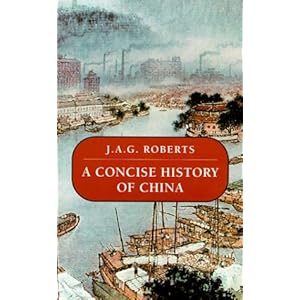
A Concise History of China

Book: A Concise History of China by J. A. G. Roberts

Country: China


Description: The centuries-long complexity of China's political experience, the richness of its culture, and the drama of its economic unfolding are the hallmarks of this short but sweeping history. China's own history is entwined with its response to the West in a rich tapestry depicting its peoples, rulers, and society. More than a nuanced history of a vast continent, this study is sensitive to the multifaceted and changing interpretations of China that have been offered over the years.

In this overarching book, J. A. G. Roberts refers to recent archeological finds--the caches of bronze vessels found at Sanxingdui--and to new documentary reevaluations--the reassessment of Manchu documentation. The first half of the book provides an up-to-date interpretation of China's early and imperial history, while the second half concentrates on the modern period and provides an interpretive account of major developments--the impact of Western imperialism, the rise of Chinese Communism, and the record of the People's Republic of China since 1949. (from amazon.com)

This book was certainly very concise--4,000 years of Chinese history in 300 pages! For all that, however, it was very informative, and I do feel as if I now have a good overview of Chinese history, especially politics. I do wish Roberts had focused more on social changes as well as politics, simply because I find that more interesting but I also know that those parts of history are less clear-cut and less documented.

The other problem with this being such a short history was that it almost raised more questions than it answered. So many interesting people appeared quickly and then were gone, like the Empress Wu, the only empress in Chinese history, or Ding Ling, a writer in early communism. It also, at least for me, raised bigger questions about my view of Chinese culture and history, as a Westerner and as a Christian. In that sense, it was a book that led to a lot of reflection during and after I was reading.

Saturday, September 29, 2012

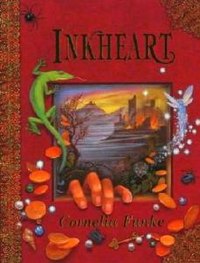
Inkheart


American cover
Book: Inhkeart by Cornelia Funke

Published: 2003

Description: Meggie lives a quiet life alone with her father, a book-binder. But her father has a deep secret-- he posseses an extraordinary magical power. One day a mysterious stranger arrives who seems linked to her father's past. Who is this sinister character and what does he want? Suddenly Meggie is involved in a breathless game of escape and intrigue as her father's life is put in danger. Will she be able to save him in time? (from Amazon.com)


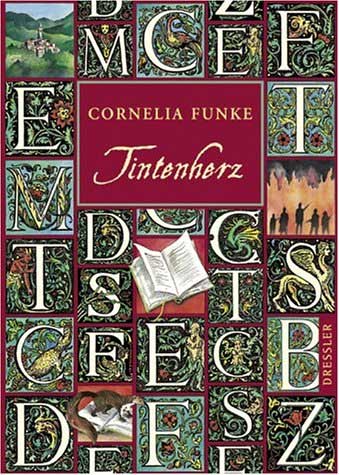
Original German cover


This was my second reading of this book, and both times I've really enjoyed it. It's absolutely wonderfully written--the descriptions are wonderful, and the characters feel amazingly real. Especially the main characters felt like real people, in that their reactions to the often dangerous situations they were thrown into wasn't, "OK, I'm going to be brave and face death to do the right thing." It was, "I'm afraid, because my life is in danger. I don't know what to do!" Many of the characters also develop throughout the book, becoming more able/willing to deal with those situations and conquer their fear of death/pain. A lot of the characters were also a lot of fun, especially Elinor. 

My absolute favorite aspect of Inkheart is the love of books that completely permeates it. Each chapter begins with a quote from a book, and books are constantly being referenced. As someone who loves books so much, I love books that portray characters with the same love. It also plays with the border between stories and reality in a lot of ways. But I will say that I also appreciated the fact that books were not shown as the ultimate solution to all problems. Books were good, perhaps even to the point of a certain amount of obsession, but characters who tried to gain strength from books failed. Books did not just solve all problems.

An extremely enjoyable, absorbing tale--well-written and well worth the time put into it.

Thursday, September 27, 2012

Snow Flower and the Secret Fan


Book: Snow Flower and the Secret Fan by Lisa See

Country: China


Description: A language kept a secret for a thousand years forms the backdrop for an unforgettable novel of two Chinese women whose friendship and love sustains them through their lives.

This absorbing novel – with a storyline unlike anything Lisa See has written before – takes place in 19th century China when girls had their feet bound, then spent the rest of their lives in seclusion with only a single window from which to see.  Illiterate and isolated, they were not expected to think, be creative, or have emotions. But in one remote county, women developed their own secret code, nu shu – "women's writing" – the only gender-based written language to have been found in the world.  Some girls were paired as "old-sames" in emotional matches that lasted throughout their lives.  They painted letters on fans, embroidered messages on handkerchiefs, and composed stories, thereby reaching out of their windows to share their hopes, dreams, and accomplishments.
An old woman tells of her relationship with her "old-same," their arranged marriages, and the joys and tragedies of motherhood—until a terrible misunderstanding written on their secret fan threatens to tear them apart. With the detail and emotional resonance of Memoirs of a Geisha ,Snow Flower and the Secret Fan delves into one of the most mysterious and treasured relationships of all time—female friendship. (from lisasee.com)
My first descriptive word for this book would be sad or poignant. It was about the lives of women in China--with their feet bound and in a strictly traditional, patriarchal society, they had very little freedom. Marriages were arranged, girls were thought of as practically worthless. The narrator, Lily, describes her life, from her girlhood and foot-binding, her marriage, and finally her old age. The novel certainly revealed a dark side of Chinese society that I'd never thought about before. I suppose every society has its dark side, but I still found it horrible. Perhaps it was because it was occurring in another culture, and I fell more free to criticize it, or because I haven't grown accustomed to its evils.

One of the major themes in the novel was food-binding. It was something that all the women in the novel accepted despite the pain--not only to themselves as girls, but also of having to do that to their daughters when they were 6 or 7. But what about the things we do today for beauty--anorexia, bulimia, plastic surgery. 

More than anything, the major focus of the novel, and certainly Lily's retelling of her life, was her friendship with Snow Flower. Typically in China, or at least in the area being described in the novel, a woman would have a group of friends (a group of sworn sisters) that would change with the different stages of her life--one for girlhood, one for old age, and so on. But Lily and Snow Flower are laotongs, which means that they will be friends for life, able to send each other letters and gifts at all ages, and meet every year at the same place.  

An emotional roller coaster, but very good. The emotions of this book were very strong, but ultimately too pessimistic for me. Perhaps I've just lived a lucky life, but life isn't all sadness. Or maybe it's because I have a wonderful God who gives me joy all the time!

Monday, September 3, 2012

Travels in West Africa


Book: Travels in West Africa by Mary H. Kingsley

Country: Guinea

Description: Unique perspective: Until 1893, Mary Kingsley led a secluded life in Victorian England. At age 30 however, Kingsley defied convention and arranged a trip to west Africa to collect botanical samples for a book left unfinished by her father. Such a daring adventure was unheard of for women at the time. Kingsley traveled through western and equatorial Africa and became the first European to enter parts of Gabon. Her story--as an explorer and as a woman--offers an enduring tale of adventure. Adventure writer and historian Tony Brandt sets Kingsley's Africa against the history of other European explorations of the continent and details her contributions not only to literature, but science as she collected more than 400 samples--some now extinct--of plants and insects. Handsome editions, competitively priced: Gathered together for the first time in inexpensive, accessible editions, Adventure Press Classics offer readers the opportunity to build a comprehensive library of the most adrenaline-packed tales of adventure ever written. She was the first Englishwoman and the "third Englishman," as she put it, to climb the great peak of the Cameroons. She traveled with native guides but otherwise without a man along into some of West Africa's most dangerous jungles, up its most dangerous rivers. She fought off crocodiles with a paddle, hit a leopard over the head with a pot, fell into an animal trap lined at the bottom with sharpened sticks, waded through swamps in water chin deep. Then she wrote this book, which describes her adventures in detail, as well as her discoveries as a naturalist and her observations of the Africans and their customs. She writes a brisk engaging prose and she is clearly dauntless. The book was no. 18 on the Adventure list of the 100 best adventure books. It's a wonderful read. (from amazon.com)

Country: Guinea


Time: Set in 1893

My Review: 

One of the things I enjoyed most about this book was the humor--very dry and British, and exactly how I like it. Here are a few examples: 
When you spend the day on shore and when, having exhausted the charms of the town, - a thing that usually takes from between ten minutes to a quarter of an hour, - you apply to an inhabitant for advice as to the disposal of the rest of your shore leave, you are told to “go and see the coals.”  You say you have not come to tropical islands to see a coal heap, and applying elsewhere for advice you probably get the same.  So, as you were told to “go and see the coals” when you left your ship, you do as you are bid.  These coals, the remnant of the store that was kept here for the English men-of-war, were left here when the naval station was removed.  The Spaniards at first thought of using them, and ran a tram-way from Clarence to them.  But when the tramway was finished, their activity had run out too, and to this day there the coals remain.  Now and again some one has the idea that they are quite good, and can be used for a steamer, and some people who have tried them say they are all right, and others say they are all wrong.  And so the end of it will be that some few thousand years hence there will be a serious quarrel among geologists on the strange pocket of coal on Fernando Po, and they will run up continents, and raise and lower oceans to explain them, and they will doubtless get more excitement and pleasure out of them than you can nowadays. (chapter II) 
Also:
All West African steamers have a mania for bush, and the delusion that they are required to climb trees.  The Fallaba had the complaint severely, because of her defective steering powers, and the temptation the magnificent forest, and the rapid currents, and the sharp turns of the creek district, offered her; she failed, of course - they all fail - but it is not for want of practice.  I have seen many West Coast vessels up trees, but never more than fifteen feet or so. (Chapter IV)
The one problem I had with the humor was that sometimes it was aimed at the Africans and often (but not always) came off as critical and snobbish.

The other aspect of this book that I really enjoyed were the descriptions of Africa--the various tribes and their cultures, the white society there, the traveling, and most especially the African landscape: 
The beauty of the night on Kondo Kondo was superb; the sun went down and the afterglow flashed across the sky in crimson, purple, and gold, leaving it a deep violet-purple, with the great stars hanging in it like moons, until the moon herself arose, lighting the sky long before she sent her beams down on us in this valley.  As she rose, the mountains hiding her face grew harder and harder in outline, and deeper and deeper black, while those opposite were just enough illumined to let one see the wefts and floating veils of blue-white mist upon them, and when at last, and for a short time only, she shone full down on the savage foam of the Alemba, she turned it into a soft silver mist.  Around, on all sides, flickered the fire-flies, who had come to see if our fire was not a big relation of their own, and they were the sole representatives, with ourselves, of animal life.  When the moon had gone, the sky, still lit by the stars, seeming indeed to be in itself lambent, was very lovely, but it shared none of its light with us, and we sat round our fire surrounded by an utter darkness.  Cold, clammy drifts of almost tangible mist encircled (Chapter V).  


I decided to read this book because heard that Kingsley one of the few travelers of the time who respectived African culture, and I largely found this to be true. She respected not only African culture, but also Africans themselves: "I confess I like the African on the whole, a thing I never expected to do when I went to the Coast with the idea that he was a degraded, savage, cruel brute; but that is a trifling error you soon get rid of when you know him" (Chapter XXI). Kingsley acknowledged that African culture was different than European culture, and that customs that worked in Europe might or would not work in the competeley different culture (and climate) of Africa (not even beginning to think about each unique tribe). She therefore blamed the missionary schools for a lot of the problems in West Africa (present-day Guinea) because they unsuccessfully tried to tranplant Africans into a European way of thinking and really just confused/ruiend them (morally, I mean--they were often very successful traders). At the same time, though, Kingsley out and out says that she thinks African culture is inferior to European culture and that Africans are incapable of reaching the "heights" of European culture. I don't agree (although it's not true that European culture is "best"--we have plenty of our own problems--and so there's no reason for Africans to be forced to Europeanize), but I think it shows how illogical we can all be at times. In many ways this book was extremely honestly written, and it reveals a lot about Kingsley's thought processes and biases. 

Kingsley's ideas on gender also complex. Kingsley was a white woman, alone, journeying through dangerous country, searching for scientific specimens--not exactly traditional. She makes several comments about the cluelessness of men, she seems to almost relish her freedom from a husband: "as for the husband, neither the Royal Geographical Society’s list, in their ‘Hints to Travellers,’ nor Messrs. Silver, in their elaborate lists of articles necessary for a traveller in tropical climates, make mention of husbands" (Chapter V). At the same time, though, she could be very traditional: she wore a skirt for the whole journey, and even says once that men are superior to women.


Be warned, however, that parts of the book could be boring, such as Kingsley's recommendations on creating a trade empire in British Africa.