Wednesday, December 26, 2012

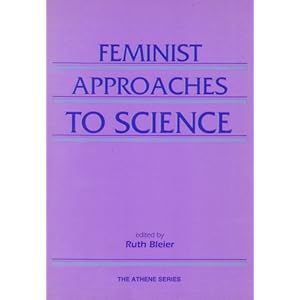
Feminist Approaches to Science

Book: Feminist Approaches to Science, edited by Ruth Bleier

Published: 1986


Description: A collection of essays looking at feminist theory and how it relates to science, how science is practiced, and how it can improve scientific thought. (My description)


Perhaps I should begin by stating that I am not a feminist. I simply read part of this book for a class, was intrigued, and checked it out so I could read the rest of it.


I thought this was a really, really good book. It was very thought-provoking. The whole idea behind this book was the critique science from a feminist perspective. I don't totally identify with such a perspective, but they did raise many very good points about problems that existed when the book was written (1986) and, I would argue, are still problems today. Their ultimate point was that science is not practiced in a vacuum. Scientists are not somehow perfect and without bias as they practice science. Scientists are influenced by the society around them, by racism, sexism, classism, whatever, and this affects how they interact with their work and with other scientists or would-be scientists. I found their argument interesting both because it's something that science today still needs to hear, and because it applies not just to women in science and how they're treated, but how all of science is done and how that applies to arguments about creationism (something I'm always interested in). 


I had one major critique of this book: Authors seemed to argue both that men and women are exactly the same and should be treated as such, and that women have a different perspective and way of thinking than men and therefore perform science differently. I believe this was partly caused by the different authors of the essays, but it is definitely a problem in their logic.

Thursday, December 20, 2012

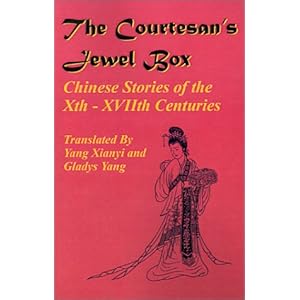
The Courtesan's Jewel Box

Book: The Courtesan's Jewel Box

Country: China


Description: This is a selection of popular Chinese stories from the 10th to 17th centuries. These stories were written in the spoken language that developed as a literary medium after the emergence of an urban commercial economy in the Song Dynasty (A.D. 960-1279). Originally the manuscripts of ordinary street story-tellers, this genre of fiction –deriving its material from the life and times of the period, with vivid writing and intricate plots, descriptions that are natural and vivacious– has now attained a lofty place as literature.
The twenty stories in this book were selected from over two hundred in several collections published at the beginning of the 17th century. (from Amazon.com)

This was a good book, I thought. It gave me a much better feel for what it would actually be like to live in China than either of the other two books I've read about China. The stories in this book were purposefully mostly about normal people, so I got a feel for the customs of China. This included the fact that women were only bargaining chips in some of the stories (but not all), the fact that men could have more than one wife, the social structure of China, the mixture of religions, the fact that money is carried around on strings, and lots of other small but interesting facts.

Since it was an anthology, there was a mixture of stories, some better than others. Some of my favorites were "The Courtesan's Jewel Box" (a love story) and "Lazy Dragon" (the story of, essentially, the Chinese version of Robin Hood).

Would recommend to anyone with an interest in traditional Chinese culture.

Monday, December 17, 2012

I, Robot


Book: I, Robot by Isaac Asimov

Description: The three laws of Robotics:
1) A robot may not injure a human being or, through inaction, allow a human being to come to harm
2) A robot must obey orders givein to it by human beings except where such orders would conflict with the First Law.
3) A robot must protect its own existence as long as such protection does not conflict with the First or Second Law.

With this, Asimov changed our perception of robots forever when he formulated the laws governing their behavior. In I, Robot, Asimov chronicles the development of the robot through a series of interlinked stories: from its primitive origins in the present to its ultimate perfection in the not-so-distant future--a future in which humanity itself may be rendered obsolete.

Here are stories of robots gone mad, of mind-read robots, and robots with a sense of humor. Of robot politicians, and robots who secretly run the world--all told with the dramatic blend of science fact & science fiction that became Asmiov's trademark. (from Amazon.com)

This was a really though-provoking book. Asimov trying, really, to create ideal men with his robots, something made rather clear as Dr. Calvin listed the three things humans should do--and they were in the opposite order as the 3 Laws of Robotics, ie what should be important to humans was actually important to robots. I must say that I rather objected to the fact that humans were capable of creating such perfect beings--as fallen creatures, I doubt that we have it in us. Also, of course, creating is God's job, not ours. But... although the robots felt very human, does having a bit of a personality make them human? It makes them appear human, but...

The overall feel of these stories was rather creepy, which was odd, because not sure it was meant to be creepy, and none of the other robots were. There was very much a sense of controlled danger with robots, considering that they had the power to get rid of humans. At the same time, there was also very much a sense of 'progress is always good.' The Fundamentalists, who who were against technology in general (including robots), were seen as essentially ostriches who were ignoring reality. So there was a really interesting interplay between those two  ideas.

Donovan and Powell were by far the most entertaining characters--their stories reminded me of something out of Star Wars, complete with the kindly scoundrels and the throwing around of technical terms and the large amount of dangerous situations. Most of the other characters were good--Dr. Calvin was awesome. Loved her! My big problem with the characters was that they were all too good--I know optimism was running high in the 50s, but I really can't see humans all binding together on a planetwide basis. It's just not in our fallen nature (and would we really want to? Asimov's imagination of a peaceful world was also an almost entirely homogenous world, and God loves our uniqueness, too). And almost everyone was ultimately good, a bit creepily so. Even the obnoxious company executives or whatever just seemed slightly misguided but ultimately well-meaning.

There was also some subtle hostility to religion: Like the robot who believed that a bigger robot was a god who had created him--he just looked silly. But actually a rather good metaphor for human existence in a way--we don't understand everything because of our limited human perspective, and therefore often can't see God and His hand and His truth, even when it's really obvious from a different perspective. 

This was a gripping, thought-provoking read that I enjoyed and would highly recommend. 

Thursday, December 6, 2012

Around the World in Eighty Days


Book: Around the World in Eighty Days by Jules Verne

Published: 1873  

Description: For a bet, Phileas Fogg sets out with his servant Passeportout to achieve an incredible journey - from London to Paris, Brindisi, Suez, Bombay, Calcutta, Singapore, Hong Kong, San Francisco, New York and back to London again, all in just eighty days. There are many alarms and surprises along the way - and a last minute setback that makes all the difference between winning and losing. (from Amazon.com)

I very very much enjoyed this classic, for many reasons.

I loved everywhere they visited. Verne portrayed it all as beautiful and wonderful. The brief glimpse of every place Fogg and his party went made me want to read more about all of them (or better yet, visit!). Too bad there's such an element of colonialism and racism in that--these places aren't better because the people are childlike, innocent, or any other odd/stupid notion like that. I'd also say that Verne picked the worst local custom ever in every place and made them live through it.  

Their whole journey through America was hilarious. I loved both the scene with the bison and the scene with the snow-boat. Verne's descriptions of nature in general were beautiful. I think the bison example stuck with me so well because bison are a pretty well known example of humans driving a species almost to extinction. Can you imagine there being so many bison crossing the tracks that the train was stopped for three and a half hours??? 

This book was also very much about slowing down versus doing as much as possible, something I've been struggling with lately, so I really resonated with the book. I enjoyed Fogg's adventures a lot, but his focus on the goal rather than the amazing journey he's on seemed rather silly and closed-minded to me. (Despite doing it all the time!!) But it did make me sit back and want to savour his adventures all the more because Fogg wasn't.

Overall, a book I would highly recommend for a fun read.

Saturday, December 1, 2012

Hallowe'en Party


Book: Hallowe'en Party by Agatha Christie

Description: Mystery writer Ariadne Oliver has been invited to Woodleigh Common, where a Hallowe'en party is underway for a group of local adolescents.. One of the guests is a young girl known for telling tall tales of murder and intrigue. When the girl is found drowned in an apple-bobbing tub, Ariadne wonders just how tall her latest tale was. Which of the party guests wanted to keep her quiet? Unmasking a killer this Hallowe'en isn't going to be easy for Hercule Poirot - there isn't a soul in Woodleigh who believes this little storyteller was even murdered... (from agathachristie.com)

Christie is one of my all-time favorite mystery writers, and I think her books are perfect light reads (although they're often not as light as I expect them to be).

Christie is so good at showing human nature, and this book is full of human moments. My favorite was when Poirot's friend Ariadne Oliver sees two teenagers kissing in front of a door she needs to get through. She has to practically push her way through, and she thinks, "How selfish people are." At the same time, she hears the teens say, "How selfish people are. Couldn't she see that we didn't want to be disturbed?"

Possibly my favorite place in the book was the quarry garden (although it got more and more creepy as the book went on). It sounded so beautiful! Here's a picture of a rock garden in Vermont that looks very similar to how I imagined the garden in Hallowe'en Party:

Photo Source

Poirot is arrogant but cute. I most definitely wouldn't want to actually know him, but he's so fun to read about!

Wednesday, November 28, 2012

Global!

In the past few days, I've really been thinking about my global perspective. There was the news about the factory fire in Bangladesh (read about it here) and, on a more positive note, the story of the British man who visited every country in the world without flying anywhere (read about it here). Then I took an online quiz to name every country in the world, and I could only name 101/196. How sad is it that I know so little of the world I live in that I can only name half of the countries? And most of those places are nothing more than names to me--St. Lucia, Belize, Mali, Kyrgyzstan, Togo, Kiribati? I know nothing about these countries but their names!

All this has just made me more determined to read two books from every country in the world, and to start branching out from countries that I already know a fair bit about. I can't wait to learn more about all the diversity of God's children on this earth!

Sunday, November 25, 2012

The Craft of Research


Book: The Craft of Research by Wayne C. Booth, Gregory C. Colomb, and Joseph M. Williams

Description: With more than 400,000 copies now in print, The Craft of Research is the unrivaled resource for researchers at every level, from first-year undergraduates to research reporters at corporations and government offices.
 
Seasoned researchers and educators Gregory G. Colomb and Joseph M. Williams present an updated third edition of their classic handbook, whose first and second editions were written in collaboration with the late Wayne C. Booth. The Craft of Research explains how to build an argument that motivates readers to accept a claim; how to anticipate the reservations of readers and to respond to them appropriately; and how to create introductions and conclusions that answer that most demanding question, “So what?”
 
The third edition includes an expanded discussion of the essential early stages of a research task: planning and drafting a paper. The authors have revised and fully updated their section on electronic research, emphasizing the need to distinguish between trustworthy sources (such as those found in libraries) and less reliable sources found with a quick Web search. A chapter on warrants has also been thoroughly reviewed to make this difficult subject easier for researchers
 
Throughout, the authors have preserved the amiable tone, the reliable voice, and the sense of directness that have made this book indispensable for anyone undertaking a research project. (from Amazon.com)

For a book with such an uninteresting-sounding title (although I do love research), this was a very interesting read. The authors' passion for research, especially well-done research, really shines through. They also point how vital research is to society--I've never seen the earth from space, so I don't know that it's round, but I trust the reliable people who've done research on the topic and tell me that it is. If people blatantly deceive with their research, society will suffer.

Their work also very much influenced by the that everything we do is really standing on work that others have done before us. Just really cool admission, and something I love to think about.

Probably the thing that I enjoyed the most about this book was that the authors' characters really came through--it wasn't just a bland "An introduction should have..." kind of book, but rather an engaging, witty work about how to really think about your own and others' research.

Thursday, November 22, 2012

Parzival


Book: Parzival by Sir Wolfram von Eschenbach

Country: Germany


Written: around 1197-1215

Description: Composed in the early thirteenth century, Wolfram von Eschenbach's Parzival is the re-creation and completion of the story left unfinished by its initiator Chretien de Troyes. It follows Parzival from his boyhood and career as a knight in the court of King Arthur to his ultimate achievement as King of the Temple of the Grail, which Wolfram describes as a life-giving Stone. As a knight serving the German nobility in the imperial Hohenstauffen period, the author was uniquely placed to describe the zest and colour of his hero's world, with dazzling depictions of courtly luxury, jousting and adventure. Yet this is not simply a tale of chivalry, but an epic quest for spiritual education, as Parzival must conquer his ignorance and pride and learn humility before he can finally win the Holy Grail. (from Amazon.com)

This was a really wonderful poem. Parzival's story is a great story of someone growing from an ignorant boy to an arrogant young man to a humble Christian. There were several scenes that I absolutely loved: when Parzival was so love-sick for his wife that he couldn't fight (there was a beautiful description of love!), and when Parzival went to the hermit and talked with him about God and ultimately gave his life to Him. Many of the objections Parzival raised to the existence of God are questions that people still have. It was good to hear these questions in a story written almost 1,000 years ago. We are not alone in the questions we have. Parzival's story is the story of many of us.

This may be silly, but one of the things that surprised me in reading this was how much this epic was like more modern works of fiction. The descriptions were very detailed at times, and they definitely conjured up a world for me. There was also an amazing, and unexpected, emotional depth in this story. Perhaps they resonated with me so well because so many of these emotions were being ultimately constrained and dealt with in the context of the overarching Christianity of most of the characters.

There were a few aspects of Parzival that I didn't like. For some reason, however, less than half of this epic is actually about Parzival. There are two chapters about his father, Gachmuret, and the rest is about Gawain--who was cool and all, but Parzival was better. Also, most of the characters see baptism as the ultimate sign of a relationship with God, which obviously isn't true. So do just keep that in mind.

Overall, however, this was a wonderful epic poem, with an inspiring plot and realistic Christian characters.

Saturday, November 10, 2012

The Neverending Story


Book: The Neverending Story by Michael Ende

Description: Shy, awkward Bastian is amazed to discover that he has become a character in the mysterious book he is reading and that he has an important mission to fulfill. (from Amazon.com)

I really enjoyed this story. In many ways it felt like reality-- the fact that the narrator acknowledged all the other stories that were woven into Bastian's, the emotional turmoil that Bastian especially went through, and the emotional truths that were woven into the story. Ende did a fantastic job with the world-building--Fantasia felt like a real place, even though it was a fantasy world (something that even the story acknowledged), I really enjoyed all the small details like the hint that Shakespeare came to Fantasia, and all the peoples and places that he created were very cool. Overall, I think that feel of Fantasia was the feel of a world in an epic poem like Parsival--people are either good or bad, people do great deeds, the world seems magical and the main character must go through some trial of character (although it also acknowledged the real world through Bastian's early experiences, and really played with the idea of books versus reality. In that regard it really reminded me of Inkheart). The play between fiction and reality was very well-done and mind-boggling.

Although I didn't realize this until almost the last page of the book, I think that the main reason I enjoyed it so much was because The Neverending Story is an allegory for the Christian life and a Christian's relationship with fantasy and fiction in general. The main themes are the invasion of the (fantasy) world with nothingness and staying true to your self. Here I don't mean the stereoytpical sort of "stay true to yourself" advice that people give at graduations or whatever. Throughout the story Bastian wishes that he could be more and more like his idea of a 'perfect' boy (i.e. handsome, without fear, physically strong, etc.), but as his wishes are fulfilled he forgets about how he was before his wish and becomes more and more arrogant and self-centered. You do not stay true to yourself by seeking to fulfill your shallow, often societally-driven wishes, but when you realize who you truly are--a child of God, created to love others and God and be His hands and feet--and seek to stay true to who you are. Ende is not so explicit, and God is never mentioned, nor is there an obvious God figure such as Aslan in The Chronicles of Narnia. Perhaps that is why this book isn't a widely-acknowledged Christian allegory, like some other novels, and still read and enjoyed by plenty of non-Christians.

Tuesday, October 23, 2012

A Matter of Days


Book: A Matter of Days by Hugh Ross

Description: An old-earth view takes on the challenges of young-earth proponents through a study of history, Scripture, and nature-and a testable creation model. (from Amazon.com)

This was a really good book. I found it thought-provoking and well-reasoned. It's about reasons, both Biblical and scientific, to believe in long creation days. By long creation days Ross meant "days" representing epochs rather than literal 24-hour days. Also focused on fostering reconciliation between people who believe in long vs. short (24-hour) creation days.

I would highly recommend this book to anyone curious about creationism, of any kind. It was much better and more accessible than Fingerprint of God, another Hugh Ross book--there was much, much less math, and all the science he uses as evidence is much better explained. There was also nothing theologically objectionable about this book--Hugh used just as much Biblical evidence to support his claims as scientific, if not more. He assumes that the Bible is absolutely true--every single word. It's an amazing point to start from. (There are some cool Bible verses that support current science!)


As is probably obvious by now, I do not believe in creation taking place in 6 24-hour days. I believe that evolution has happened in the past, and to some extent is happening in the present day. Why? Firstly, evolution is something that is happening, according to science, and it's something that scientists have figured out to a decent amount. Life does not stay the same. Why would God create a world that seemed to be billions of years old, where evolution appeared to be happening and have been happening for billions of years, if that wasn't true? That would be lying, and God doesn't lie. Obviously not all of science is right, but evolution is something that has stood up to tests for over a hundred years and been tested by literally millions of scientists. I think it's reasonable to accept that it has happened and is happening, at least to some extent.

Please don't get me wrong--I absolutely believe in God, specifically the God of Christianity who sent His son to die for our sins. I just also believe that evolution is perfectly compatible with Christianity and the God of the Bible. There are a lot of holes in the theory of evolution as it's argued by the scientific community in general. It continues to argue that evolution is a purely random process, when mathematics show that the chances of that, and of life evolving in only 3 billion years, are so unbelievable miniscule. It continues to argue that evolution is a purely random process, when all of life seems to have been preparing earth for humans to live there: the fact that water is exactly perfect to support life (for instance being lighter frozen, allowing warmer water to stay protected from the colder temperatures and therefore allowing life to live in it); the asteroid that wiped out the dinosaurs, allowing humans to evolve from the mammals of the time; cyanobacteria evolving photosynthesis, which creates oxygen as a byproduct and eventually led to the evolution of creatures that need oxygen to breathe (like us); the fact that life has always shows a tendency to become larger and larger. There's also so much that evolution can't explain about life itself; all of the important evolutionary 'innovations' (the origin of life, having multiple cells working together, moving from the ocean to land, flight) are things where scientists can clearly see the stages, but are completely incapable of figuring out why or how the first stage led to the second one. To me, that points to God.

The other aspect of evolution that, to me, points to God is how evolution happens. There's a lot of talk about natural selection in many discussions of evolution, but the truth is that, at least in the scientific community, most scientists today believe that random chance is the single largest driving factor of most evolution. The reason most populations that are separated from each other become so different as to become separate species is not because of natural selection leading to different adaptations; it's because of randomness in their environment (like a flood that wipes out half of the population) or their genes (a mutation, or purely in which genes get passed on and which don't) that is the reason that most populations become different enough to be seen as different species. Except, of course, that as a Christian I believe that nothing is random. God has His hand in everything, and everything happens for a reason. All of those 'random' occurrences in evolution are really God, shaping life to become how He wants it.