Thursday, August 29, 2013

The Gospel of Ruth

Book: The Gospel of Ruth: Loving God Enough to Break the Rules by Carolyn Custis James

Description: Traditionally, the book of Ruth is viewed as a beautiful love story between the submissive Ruth and Boaz, the Kinsman Redeemer. But when author Carolyn Custis James began digging deeper, she found startling revelations. Three lives converge in a powerful alliance that transforms their lives and changes the world. Naomi, Ruth, and Boaz discover God makes much of broken lives, that he calls men and women to serve him together, and that he's counting on his daughters to build his kingdom. (Back of the book)

My Thoughts: The Gospel of Ruth was an excellent, excellent book, written passionately, thoughtfully, and knowledgeably. As a woman, I deeply appreciated her candid, well-researched look at women and their place in God's kingdom, as examined in the book of Ruth, as well as her own honesty with the reader.

James provides excellent historical and cultural context to help readers understand what was truly going on in the book of Ruth, such as the true desperation of widowhood in Biblical times (and in many patriarchal societies today) and how little power women had in such societies. Her explanations deeply richened and changed my understanding of the book of Ruth and of the lives of all women in the Bible.

The Gospel of Ruth argues against the idea that the book of Ruth is just a romance; instead, James views it as a story of suffering and passionate seeking after God. I especially appreciated that she didn't shy away from the suffering of most of the characters in Ruth or try to minimize it in any way--Ruth having a new husband at the end if the story doesn't lessen the loss and pain of the death of her first husband, or eliminate the memory and pain of her earlier hard times in Bethlehem. James also didn't shy away from the suffering in her own life, opening up about several difficult times in her own life.

Finally, The Gospel of Ruth was a passionate cry for women to be a part of God's kingdom and God's redemption of our broken, fallen world. He loves us and calls us to be a part of His purposes just as much as any man.

A beautiful, well-written book about women and men, and their place in the Kingdom of God. I literally enjoyed The Gospel of Ruth so much that I read it in three days, and I can't wait to read more of James' books. I so highly recommend it!

Monday, August 26, 2013

The Eternity Code

Once again, I would like to apologize for not posting last week. End-of-summer laziness caught up to me. I can't wait to go back to school!

Book: The Eternity Code by Eoin Colfer

Description: Artemis Fowl is going straight. As soon as he pulls off the most brilliant criminal feat of his career.

At least, that’s the plan when he attempts to sell his C Cube, a supercomputer built from stolen fairy technology. When his efforts to broker a deal for the Cube with a powerful businessman go terribly wrong, his loyal bodyguard and friend Butler is mortally injured. The only thing that will save him is fairy magic, so once again he must contact his old rival, Holly Short. (from Amazon.com)


My Thoughts: I've loved the Artemis Fowl series for a long time (although less so the last three books--the first four or five books are the best), and The Eternity Code is my favorite of the series.

The Eternity Code is the best of Artemis Fowl. There's lots of witty dialogue and narration, plus a healthy dose of satire aimed at anyone who takes him- or herself too seriously. I love... well, all the characters, actually. Holly and Butler are both kick-butt awesome, Artemis is intelligent and sarcastic, Foaly is just such a smart-aleck... ah, I love them all!

I think I also enjoy The Eternity Code because it is the first book where we see Artemis begin to become less of a robot. In the first two books he mainly wants things for himself, normally ridiculously greedy things (like a ton of gold bars), and only occasionally do we see a nicer side of him. In The Eternity Code, however, he is working entirely for the good of others throughout the book.

Also, I have such a weakness for clever thief stories, and this is a great one. The plot is intelligent and well put-together, and the villain is entertainingly evil and smart.

A fun, entertaining read with a smart plot, and fast-paced enough to keep anyone glued to the pages.

Friday, August 16, 2013

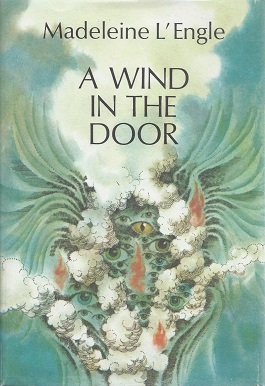
A Wind in the Door

Book: A Wind in the Door by Madeleine L'Engle

Published: 1973

Description: It is November. When Meg comes home from school, Charles Wallace tells her he saw dragons in the twin’s vegetable garden.  That night Meg, Calvin and C.W. go to the vegetable garden to meet the Teacher (Blajeny) who explains that what they are seeing isn’t a dragon at all, but a cherubim named Proginoskes.  It turns out that C.W. is ill and that  Blajeny and Proginoskes are there to make him well – by making him well, they will keep the balance of the universe in check and save it from the evil Echthros.  

Meg, Calvin and Mr. Jenkins (grade school principal) must travel inside C.W. to have this battle and save Charles’ life as well as the balance of the universe. (from amazon.com)

My Thoughts: I read A Wind in the Door at a point in my life when I was feeling very depressed and alone, and it was such a perfect balm for my mood that I read it through the night. It's a beautiful novel of fighting against the darkness no matter what--even when you don't understand. Obedience to what you know is right and what those above you (arguably God in this novel, although He's never explicitly mentioned) say needs to be done was a huge theme running through this book, a theme that I needed to hear.

I loved L'Engle's portrayal of science in A Wind in the Door. Science was something worth pursuing, something that could be used to further our understanding of the world (something that was portrayed as a worthy goal in and of itself). The existence of cherubim and all manner of other "supernatural" beings was never portrayed as contradictory to science, but actually complemented it and made it a more complete picture of the world. If only science was always viewed that way!

Wednesday, August 14, 2013

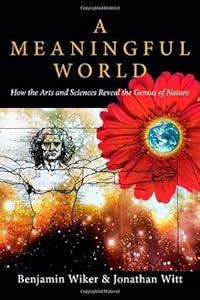
A Meaningful World

Sorry for the delay on posting this! Quite honestly, summer is getting to me and I'm feeling rather lazy. 

Book: A Meaningful World: How the Arts and Sciences Reveal the Genius of Nature by Benjamin Wiker and Jonathan Witt

Description: Meaningful or meaningless? Purposeful or pointless? When we look at nature, whether at our living earth or into deepest space, what do we find? In stark contrast to contemporary claims that the world is meaningless, Benjamin Wiker and Jonathan Witt reveal a cosmos charged with both meaning and purpose. Their journey begins with Shakespeare and ranges through Euclid's geometry, the fine-tuning of the laws of physics, the periodic table of the elements, the artistry of ordinary substances like carbon and water, the intricacy of biological organisms, and the irreducible drama of scientific exploration itself. Along the way, Wiker and Witt fashion a robust argument from evidence in nature, one that rests neither on religious presuppositions nor on a simplistic view of nature as the best of all possible worlds. In their exploration of the cosmos, Wiker and Witt find all the challenges and surprises, all of the mystery and elegance one expects from a work of genius. (from Amazon.com)

My Thoughts: I loved this book. In case you haven't picked up on this yet, I love reading books about creation and evolution and the natural world, and this is one of the best that I've read, both in terms of content and in terms of the quality of writing.

Wiker and Witt took a unique approach to the problem of creationism vs. naturalism, one that is based less on science but is nonetheless perfectly valid: if the universe was created, it must have been created by a genius, and the universe would therefore have the marks of genius just like any other great work of art. Most people can agree, I think, that the universe is beautiful and intricate, at the very least; most would consider it a work of art even if they don't believe in a Creator.

What a beautiful approach!

Wiker and Witt began by examining genius in human art, namely Shakespeare's Hamlet and The Tempest, and then examined several aspects of our universe to show how they exhibit markers of genius just as the plays Hamlet and The Tempest do as well. It would be ridiculous to think that Shakespeare created each of his plays by randomly putting one letter in front of another for a hundred plus pages; how much more ridiculous is it to think of our universe, then life coming together one molecule at a time? Perhaps the most interesting argument made in favor of design was the existence of science as it does: in each discipline, the matter under study is simple enough for the first scientists to eventually discover the basics of that discipline, but the farther they delve into the subject, the more complex it becomes. If the universe was random, wouldn't at least some disciplines have complex basic rules, making it difficult to impossible for scientists to understand?

Wiker and Witt also spent a great deal of time discussing postmodernism (and to a lesser degree naturalism), drawing it out to its logical conclusion of utter meaninglessness for everything in the universe. I thought that they pounded this topic too much; it may be the logical conclusion of these philosophies, but few if any scientists (or people, for that matter) think them through so coherently. Few scientists (or people) believe in utter meaninglessness. On the other hand, it is important to realize that it is what they ultimately point to.

Perhaps my only other criticism was that Wiker and Witt dissed Charles Darwin way too much for my tastes--but then, I like Darwin. I thought they treated Darwin as if he had purposefully created a theory that argued that the world was meaningless and random, and I don't think that's true. He simply argued for a theory that does not, after a shallow examination, appear to require a Creator.

Thursday, August 8, 2013

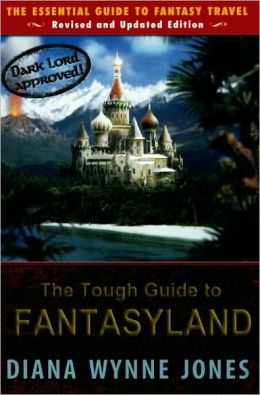
Tough Guide to Fantasyland

Book: Tough Guide to Fantasyland by Diana Wynne Jones

Description: Imagine that all fantasy novels—the ones featuring dragons, knights, wizards, and magic—are set in the same place. That place is called Fantasyland. The Tough Guide to Fantasyland is your travel guide, a handbook to everything you might find: Evil, the Dark Lord, Stew, Boots (but not Socks), and what passes for Economics and Ecology. (from amazon.com)

My Thoughts: I thought it would be fun to continue the theme of last Monday's post (that is, books that poke fun at fantasy/fairy tale cliches) with Tough Guide to Fantasyland. Rather than satirizing simply fairy tale tendencies, however, it satirizes the cliches of the fantasy genre.

Jones exposes many of the cliches of fantasy writing, and many of its flaws. She points out a lot of common plot holes (or just illogical but accepted conventions) of fantasy. This book is often recommended to potential authors, so they don't fall into many of the common plot holes and cliches in their books.

I'll admit that I don't actually read that much fantasy literature, and I still thought Tough Guide to Fantasyland was hilarious. I've read enough to know that Jones's characterization is pretty accurate.

I'll also admit that I read Tough Guide to Fantasyland is almost one sitting, and wished that I hadn't. In small doses, it's a hilarious book; in large doses, I was reminded of C. S. Lewis's words on laughter and jokes (I believe in The Screwtape Letters), where some builds up and some tears down. In small chunks, Jones's writing comes across as playful and well-meaning ribbing at a genre that Jones knows and loves; in larger chunks, it came across much more as humor that was simply jaded and trying to tear everything down.

One final warning: there are a fair number of references to sex and demons/gods, in a very light, witty manner that grated after a while. Recommended, but with caution.

Monday, August 5, 2013

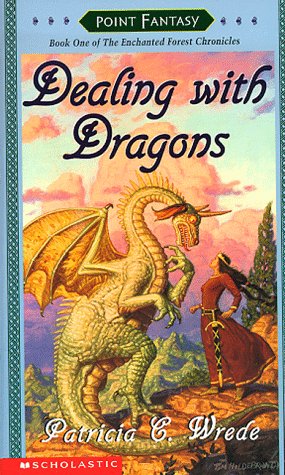
Dealing with Dragons

Book: Dealing with Dragons by Patricia C. Wrede

Description: Cimorene is everything a princess is not supposed to be: headstrong, tomboyish, smart. . . .

And bored. So bored that she runs away to live with a dragon . . . and finds the family and excitement she's been looking for. (from amazon.com)

My Thoughts: Dealing with Dragons was a super-fun book! Quite honestly, I loved it. It had a quiet sense of humor; Wrede pokes quite a lot of fun at what "should" happen in fairy tales, and often how ridiculous it is (or can be, when taken literally). Wrede also does a good job at creating a world where the rules of fairy tales are the rules of life; things like fairy godmothers, beautiful but empty-headed princesses, talking frogs, quests, and the youngest son being the sensible and honest one of the family are simply accepted facts of life.

The other aspect of Dealing with Dragons that I absolutely loved was Princess Cimorene herself: she was an intelligent and sensible heroine, a joy to read about--it was a relief to not spend a book waiting anxiously for the main character to learn some common sense. The other characters were also great to read about. There was a nice mix of the quirky, the normal, and the very obtuse. My only complaint was that all the "good" characters had no faults, and all the "bad" characters had no redeeming or even vaguely nice traits.

A fun book to read when you're looking for some light afternoon or summer reading.

Thursday, August 1, 2013

Life of Galileo

Play: Life of Galileo by Bertolt Brecht

Description: Arguably Brecht's greatest play, A Life of Galileo charts the seventeenth century scientist's extraordinary fight with the church over his assertion that the earth orbits the sun.The figure of Galileo, whose ‘heretical’ discoveries about the solar system brought him to the attention of the Inquisition, is one of Brecht’s more human and complex creations. Temporarily silenced by the Inquisition’s threat of torture, and forced to abjure his theories publicly, Galileo continues to work in private, eventually smuggling his work out of the country. (from Amazon.com)


My Thoughts: This was an interesting, thought-provoking play. I'm not sure how many of the ideas within I agreed with, but it was an excellent play for forcing me to think about what I believed about what was happening. 


My first thoughts about Galileo: he was a scientist who wanted to discover things about the world, full of optimism but also impracticality. Galileo didn't care at all that no one really wanted to know about what he was trying to discover. He refused to design useful things or take on students, and yet he somehow expected to live a lavish, comfortable lifestyle full of wine, good food, and good clothes. Oh, and he was consistently a jerk to his daughter. So I had mixed feelings about Galileo (although he did seem incredibly human).


Part of what made this play so interesting was that I could sympathize with everyone to some extent. Galilei was portrayed as a genius who ultimately just couldn't stop thinking about his discoveries (which is something I can relate to); the women around Galilei were loyal and kind; Galileo's students had a great desire for scientific truth and discovery that they refused to compromise. Even the Church men, who wanted Galilei to not publish or discover, came across as understandable to me. I'm not even sure why--they refused to even begin to think of their faith in a different way, and they ultimately force Galileo, on pain of torture and death, to recant (i.e. lie) just so they can feel better. It was like I could understand why they did it and their struggle to reconcile this new fact and their beliefs, even if I disagree with their solution. Being so closed-minded that you would rather kill than consider that you might be even slightly wrong is evil and wrong. Was Galileo right to look into the structure of the solar system? How does that knowledge help us?

What is the point of scientific discovery? It helps us discover more about God's world, which tells us more about God--but it ultimately leads to awful inventions like the atom bomb. It leads to people questioning God and unable to see Him. And yet God calls us to search for truth. The world is broken and fallen; is it any wonder that anything we discover, however good it may be, becomes twisted and used for evil?


Life of Galileo really made me think, and for that reason I enjoyed it immensely.

Monday, July 29, 2013

Harry Potter conclusion

I wanted to conclude Harry Potter month by making some observations about the Harry Potter series and its Christian content.

One of the amazing and unique aspects of the Harry Potter series is how the novels change with Harry and his friends. The series begins with a ten-year-old Harry who is innocent and in many ways ignorant (in the best sense of the word) and ends with a mature seventeen-year-old Harry who is knowledgeable of the ways of the world without being influenced by what he knows, as Christians are called to be ("wily as a serpent, innocent as a dove"), and knowledgeable about greater truths such as love and sacrifice. Rowling's writing style changes and develops with Harry, as does the structure of the books. As Harry grows, the novels become longer and more mature in content. They begin as relatively simple school stories with a few interesting twists (magic, Voldemort's lurking presence) and end as complex, mature stories of the true nature of reality and of the struggle of good versus evil, with a sensible progression from one extreme to the other.

Rowling's writing style changes as Harry does. She improves tremendously as a writer through the series, becoming much less dependent on simply telling the reader what each character appears to be feeling (although this style worked extremely well for the more satirical nature of the earlier books). She tells the reader outright less and less what Harry and his friends are feeling, with the result that it is easier and easier to sympathize with their feelings, become engaged in them, and feel their emotions yourself. As Harry and his readers mature, Rowling also moves away from simply satirizing human nature to attempting to understand why characters behave the way they do. In earlier books, the Dursleys, the Malfoys, Snape, and others are portrayed simply as hilariously awful people whose antics are entertaining; by later books, the motives of these characters have been discovered and explored. While this of course does not excuse their abhorrent behavior, it does create a certain amount of compassion for what they have gone through and why they have become the people they have become.

Something that Rowling does strongly throughout the series has to do with the morals of her stories. These morals are rarely verbalized (and normally by Dumbledore); rather, the reader is left to infer for him- or herself that it is wrong to bully, oppress, torture, hate, and so on. Prejudice and oppression are strongly condemned through despised characters such as Dolores Umbridge, as well as through acquaintance with those who are oppressed even before Voldemort returns, such as Remus Lupin, Rubeus Hagrid, Dobby, Kreacher, and perhaps even Hermione. Hagrid especially may not have had much formal schooling, but he has a huge heart that is in the right place. He is always determined to see the best in everyone and every creature (no matter how spiny, scaly, toothy, hairy, or blood-thirsty), so trusting and generous with his time, and so determined to do what he wants no matter what others think in a way that is so reminiscent of God and His best warriors here on earth. Judgments based on worldly values such as appearance or societal status are invariably wrong. This rule (show rather than tell) applies to Harry's behavior as well; he often makes bad choices that are not outright condemned, but often these behaviors are subtly punished. They are not always punished, however, and sometimes his morally wrong choices are portrayed as 'right given the situation'--a weakness of the series.

Another strength of the series, which I have touched on before, is how well Rowling builds the wizarding world around us through the years. She includes incredible amounts of detail throughout the books about both the world itself and its characters, details that weren't strictly necessary but make the world much richer and easier to imagine. She also includes an incredible amount of detail that is mentioned briefly but ends up being important later (this especially comes together in Deathly Hallows), and the amount of plotting that must have gone on before writing began is impressive.

Magic per se may not be Christian, but the Harry Potter series is. It's full of Christian symbols and symbolism, such as phoenixes and unicorns and symbolic (or actual) deaths and resurrections. Harry always receives help in his final battles--he is never able to achieve anything alone. Only with help (always from either Dumbledore or a proxy of Dumbledore) is Harry able to survive and succeed, and he is only ever able to reach the end of the book well-prepared through the help of friends. It's a wonderful representation of the Church and Christian life--no one can prevail against sin without help from both God and others.

Finally, I would like to point out how impressive a feat the Harry Potter series is. I love almost every character, and I cry every time I read Deathly Hallows--something I can say of no other book or movie. I cannot recommend this series enough, perhaps especially to Christians.

Thursday, July 25, 2013

Harry Potter and the Deathly Hallows

Book: Harry Potter and the Deathly Hallows by J. K. Rowling

Description: WE NOW PRESENT THE SEVENTH AND FINAL INSTALLMENT IN THE EPIC TALE OF HARRY POTTER. (book flap)

My Thoughts: Wow. Just wow.

Deathly Hallows is such a well-written, beautiful story. It is the story of Harry and his friends changing from school-aged young adults to true adults as they are forced to deal with the horror and cruelty of Voldemort's rule while racing to destroy him. It is the story of a people faced with unimaginable darkness that chooses to fight back no matter the cost. It is a story of hope and hopelessness, trust and friendship and love, good and evil. It is a masterpiece.

You may think I'm being dramatic. Well, maybe I am. But this is by far the best-written Harry Potter book, the most complex and beautiful. It's the only book I've ever read where I cried, not only the first time I read it, but every single time I have read it. In fact, every time I cry more rather than less. It is one of those amazing books that improves and expands with rereads rather than becoming flattened and boring.

Deathly Hallows is a complex novel. As I mentioned, it is much more adult in theme than any previous Harry Potter novel. The themes are similar to those dealt with throughout the series-- friendship, love, trust, good and evil, hope, family--but they are dealt with in much more depth and maturity than ever before. Harry discovers more about his family, Voldemort, and Dumbledore (an aspect of the novel that I especially enjoyed).

Deathly Hallows is also the most overtly Christian novel of the series. Most discussions of this aspect of the novel focus on the end, where Harry willingly dies to save everyone at Hogwarts and his sacrifice prevents Voldemort from being able to enchant them in any way. Yes, it is very Christian, but what really struck me as Christian were two other aspects of Deathly Hallows. The first was the emphasis on doing what was right, no matter what, without losing hope and without fearing death. The second was Harry's struggle to come to terms with Dumbledore's mission for him (destroying Voldemort). Harry doubts Dumbledore and what he has asked him to do, despite everything that Dumbledore has done for him and shared with him in the past. Harry struggles especially after the true reality of the situation sinks in: the seeming impossibility of his task, difficulties getting along with his friends, loneliness, the reality of Voldemort's regime, worry about friends and family left behind, and physical discomforts. The first time I realized how much like it was like my relationship was God--its difficulties, my struggles, God's trust--was when Harry makes the irrevocable decision to trust Dumbledore's judgement despite his doubts and despite the many logical reasons to go against Dumbledore's wishes. It's a truly beautiful scene when he makes the final decision to trust, especially because it comes after an emotional episode where the ultimate trust and loyalty were shown by multiple people. It truly seemed as if their courage inspired Harry to make the final step of faith.

This is a book with a very stark portrayal of the results of evil, especially the emotional results. Again, Rowling shows her mastery of writing emotions that can be truly felt by the reader. There is very little graphic violence, although much is alluded to; this is the first Harry Potter novel to contain swearing, but still few, far between, and choice. However, Deathly Hallows is stark and realistic without being hopeless; in fact, I'm not sure I've ever read a more hopeful novel. Rowling acknowledges that defying evil can be difficult and painful, but shows that it is absolutely the right choice and that one should never lose hope. She does an excellent job at showing that death is not what should be feared; rather, evil and its results should be.

The final scenes of the novel are beautiful, beautiful and tragic. Almost everyone we know fights in the final battle against Voldemort and his forces, and it is one of the best battle scenes I've ever read. The sense of hopelessness, the courage of everyone who fights, everyone's determination to do what is right no matter the consequences, the losses suffered, the tragedy, the evil against which they fight--all are palpable and combine to create a truly wonderful battle scene. I cry every time.

As the conclusion of the series, many questions from earlier books are answered. Many characters who were previously seen as evil or at least unpleasant receive grace and redemption. A few of these characters have their motives and actions explained without making them more acceptable. Rowling strives for understanding of the humanity of many characters. Harry rises to the occasion every time and reaches out to offer kindness and another chance. He has truly grown into a loving human being. Although he makes mistakes, he continues to learn from his mistakes. Ron and Hermione grow much more noticeably as well, learning to trust and offer kindness and forgiveness as well.

A wonderful conclusion to the Harry Potter series that is masterfully written and plotted. It was a joy to watch Harry and his friends complete their metamorphosis into strong, caring people and their quest to destroy Voldemort. A strong call to stand against the darkness, no matter the cost, because there is always hope.

Monday, July 22, 2013

Harry Potter and the Half-Blood Prince

Book: Harry Potter and the Half-Blood Prince by J. K. Rowling

Description: The war against Voldemort is not going well; even Muggle governments are noticing. Ron scans the obituary pages of the Daily Prophet, looking for familiar names. Dumbledore is absent from Hogwarts for long stretches of time, and the Order of the Phoenix has already suffered losses.

And yet...

As in all wars, life goes on. Sixth-year students learn to Apparate--and lose a few eyebrows in the process. The Weasley twins expand their business. Teenagers flirt and fight and fall in love. Classes are never straightforward, though Harry receives some extraordinary help from the mysterious Half-Blood Prince.

So it's the home front that takes center stage in the multilayered sixth installment of the story of Harry Potter. Here at Hogwarts, Harry will search for the full and complex story of the boy who became Lord Voldemort--and thereby find what may be his only vulnerability. (book flap)

My Thoughts: An incredible improvement over Order of the Phoenix. Harry has learned from the mistakes he made then and developed into a more mature person; although he continues to become angry and make mistakes, he also makes much more of an effort to control his emotions and to learn from what has happened to him in the past. One of the first things he says in the book, for instance, is about how he has dealt with the events at the end of Order of the Phoenix: rather than moping and fuming, as he did after the events of the fourth book, he says that he has realized that he cannot allow himself to drown in his sorrow, but must get on with his life. (Obviously this is a rough paraphrase) This is not merely something Harry says, but also something Harry acts upon on his own life, and the fact that he can talk about and have such mature attitudes shows how he has grown.

Half-Blood Prince is a fascinating book. Dumbledore plays a much larger role (and he's back to his normal self!), and he and Harry spend a lot of time exploring Voldemort's past. These journeys into the past are some of the best scenes of the book, and some of the few times where Rowling exercises her sharp wit against any particular person; as the series has become more serious and nuanced, so have her portrayals of individual characters. Perhaps the only exception to this trend is Voldemort (although he was never an object of ridicule); Voldemort's past shows him to have been consistently evil. I suppose it's in keeping with his role in the story of personifying evil. Is there ever anyone who has absolutely no glimmer of goodness inside them?

Both the beginning and end of Half-Blood Prince are great. It begins with the Muggle (non-magical) prime minister meeting with the Minister of Magic, and was a wonderful return to Rowling's satirical style. And not to give anything away about the ending, but it was fantastic. The creepiness is just palpable, the final conclusion tragic, and all is masterfully written. I cry literally every time I read it.

There's also a few really interesting side-stories. The first is about trust: Harry discovers a book that has been written in by a previous owner and begins to trust what is written in the book. As in Chamber of Secrets, the idea of trust in a book is brought up. How should we decide what books we trust? When should we stop trusting a book? The second is about Malfoy: Harry becomes obsessed with discovering what Malfoy may or may not be up to. Everyone around him tells him that it's fine, but Harry refuses to believe them. Yet his obsession accomplishes nothing, and Dumbledore had the situation under control. There were better ways for Harry to have been spending his time, but he refuses to trust Dumbledore (who tells him, several times, that it's nothing that Harry needs to worry about). How often do people do that to each other? It's also an interesting twist on earlier plots: in the first four books of the series, Harry's desire to know what was going on always led him to greater knowledge and helped save the day. However, in each of these books Harry was encouraged and supported by Dumbledore, although he often didn't know it until the end of the year.

The beginning of Rowling's wonderfully written and more mature books in the Harry Potter series. One of my favorites.